

Modern conflicts don’t begin where headlines start.
To understand today’s Iran tensions, you have to go back to 1953, when Operation Ajax reshaped history and trust forever.
👁️ Facts Over Factions.
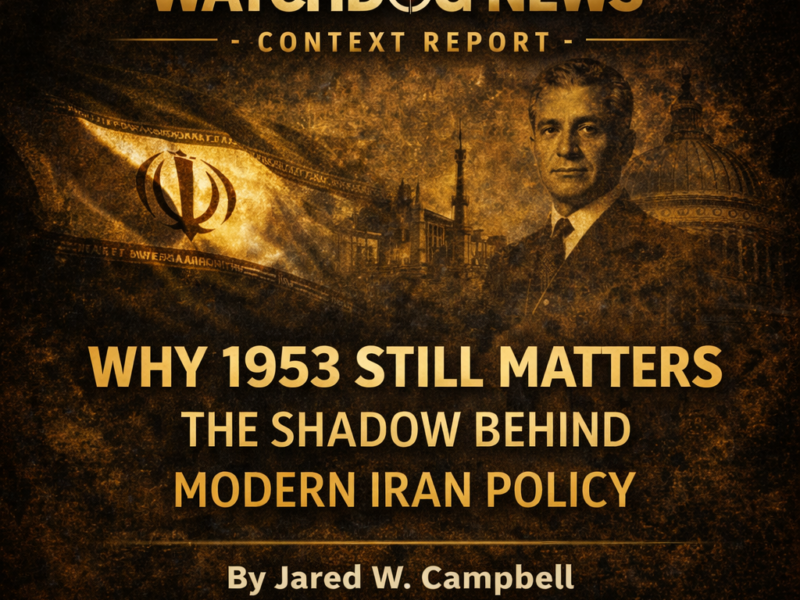
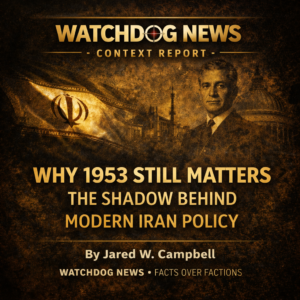
Why 1953 Still Matters: The Shadow Behind Modern Iran Policy
By Jared W. Campbell — Watchdog News
Facts Over Factions
The Crisis Before the Crisis
To understand today’s tensions with Iran, we cannot begin in 2026. We need to go back to 1953.
Long before nuclear negotiations, proxy conflicts, or modern sanctions, Iran experienced an event that continues to shape how millions of Iranians view Western actions today: the overthrow of Prime Minister Mohammad Mossadegh.
At that time, Mossadegh was not an Islamist revolutionary but a nationalist leader who sought to nationalize Iran’s oil industry, which the British-controlled Anglo-Iranian Oil Company dominated.
For Britain and the United States, the Cold War context was significant. Western leaders feared that instability in Iran could create an opportunity for Soviet influence to spread in this strategically vital region.
What followed was one of the most well-documented covert operations of the Cold War.
Operation Ajax — Regime Change Confirmed
Declassified CIA documents later confirmed that U.S. and British intelligence orchestrated Operation Ajax. This covert campaign successfully removed Prime Minister Mohammad Mossadegh from power and restored Shah Mohammad Reza Pahlavi to full authority.
The CIA’s own historical files acknowledge its involvement in organizing political pressure, propaganda efforts, and coordination with elements of the Iranian military to destabilize the government.
From Washington’s perspective at the time, the operation was seen as a geopolitical success, as it was believed to prevent what was perceived as Soviet expansion.
However, for many Iranians, it served as evidence that foreign powers could dictate Iran’s political future.
“Both interpretations exist simultaneously today.”
Accuracy check: ~92–96% (high historical reliability).
The video provides a largely accurate account of the political and economic crisis surrounding Iran’s 1951 oil nationalization and the 1953 coup that removed Prime Minister Mohammad Mossadegh. Its description of British oil interests, Cold War anxieties, internal Iranian political divisions, and the CIA–MI6 Operation Ajax corresponds closely with declassified U.S. government records and mainstream historical scholarship. While some events remain debated among historians—particularly the relative importance of foreign intelligence services versus internal Iranian actors—the overall narrative reflects established academic consensus and is suitable as a historical background source.
The Shah’s Iran — Modernization and Control
After 1953, the Shah ruled Iran for more than two decades with strong Western backing.
His government pursued rapid modernization:
-
industrial expansion,
-
infrastructure development,
-
expanded education,
-
closer alignment with Europe and the United States.
But modernization came with authoritarian rule.
The Shah’s security service, SAVAK — trained with foreign assistance — became associated with political repression, surveillance, and imprisonment of dissidents.
For supporters, the era represented stability and modernization.
For critics, it represented imposed leadership sustained through external power.
That divide never fully healed.
1979 — The Revolution That Changed Everything
By the late 1970s, economic inequality, political repression, and religious opposition converged into mass protests.
In 1979, the Shah fled Iran.
Ayatollah Ruhollah Khomeini returned from exile, and Iran became an Islamic Republic explicitly opposed to Western influence.
The revolution was not just political — it was psychological.
It reframed Iran’s national identity around resistance to foreign intervention.
This historical memory still informs Iranian leadership rhetoric today.
Accuracy check (estimated): ~85% factual accuracy. The video’s core timeline and major historical claims are broadly correct (1951 oil nationalization; 1953 CIA/MI6-backed coup; 1963 White Revolution; SAVAK repression; Khomeini’s exile/return; 1979 referendum; embassy hostages for 444 days; Iran–Iraq War). A handful of points are interpretive or contested (how “democratic” the 1979 revolution was, how decisive Carter’s human-rights pressure was, who bears responsibility for certain 1978 violence incidents). One modern-data claim—over 1,000 executions in 2025—is supported by major human-rights reporting, but depends on verification limits and counting methods.
Why This History Still Shapes Modern Conflict
When Western governments discuss pressure, deterrence, or potential regime change, many Iranian leaders — and citizens — interpret events through the lens of 1953.
Even critics of Iran’s current government often remain wary of outside intervention because history suggests outside powers may shape outcomes.
This explains why competing narratives emerge during modern crises:
-
Western narrative: pressure promotes stability or prevents larger threats.
-
Iranian state narrative: foreign powers seek domination or regime collapse.
-
Opposition narrative: external pressure may create an opportunity for internal change.
“Each narrative draws legitimacy from different historical memories.”
The Reza Pahlavi Question
Reza Pahlavi, the son of the last Shah of Iran, currently lives in exile and advocates for a democratic transition amid the Islamic Republic’s diminishing influence. For many Iranians, especially those in diaspora communities, he symbolizes a connection to a pre-revolutionary Iran that was aligned with the West. Conversely, for some Iranians, the monarchy is associated with foreign intervention and a history of authoritarian governance. This divergence in perspectives complicates the possibility of his return. The collapse of the current regime does not guarantee a unified national consensus, and historical evidence suggests that transitions in Iran have often been complex and not easily influenced by external factors.
The Watchdog Perspective
Modern conflicts are often not fully grasped through current events alone; they are shaped by memory. For Americans, today’s challenges may seem focused on security, nuclear risks, and regional stability. Yet for many Iranians, these issues resonate with a deeper narrative of sovereignty, intervention, and national identity. Each perspective offers valuable insights, and acknowledging both is essential to truly understanding the complexities at play.
Why It Matters Now
As tensions mount, both policymakers and citizens are confronted with a pivotal dilemma: Is the pressure we’re applying fostering stability, or is it merely feeding deep-rooted fears that strengthen resistance? While history may not dictate the future, it certainly sheds light on why events often deviate from the expectations of outside observers. In Iran, the threads of history are intricately woven into the fabric of the present, influencing every unfolding moment.
👁️ Jared W. Campbell
Watchdog News — Facts Over Factions