

I supported Trump.
But I also remember 2005.
When “limited strikes” become open-ended wars, veterans recognize the pattern.
The real question isn’t left vs right.
It’s whether we’re keeping the promise of “no more endless wars.”
#FactsOverFactions
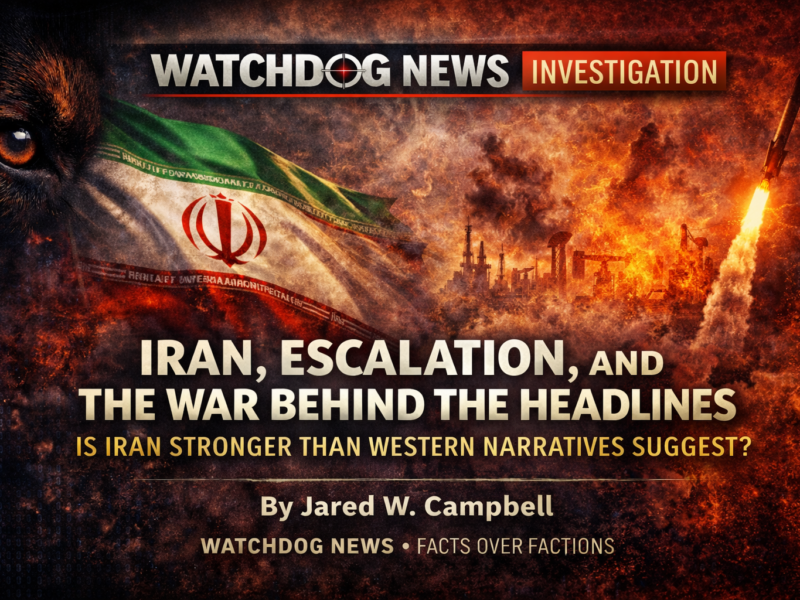
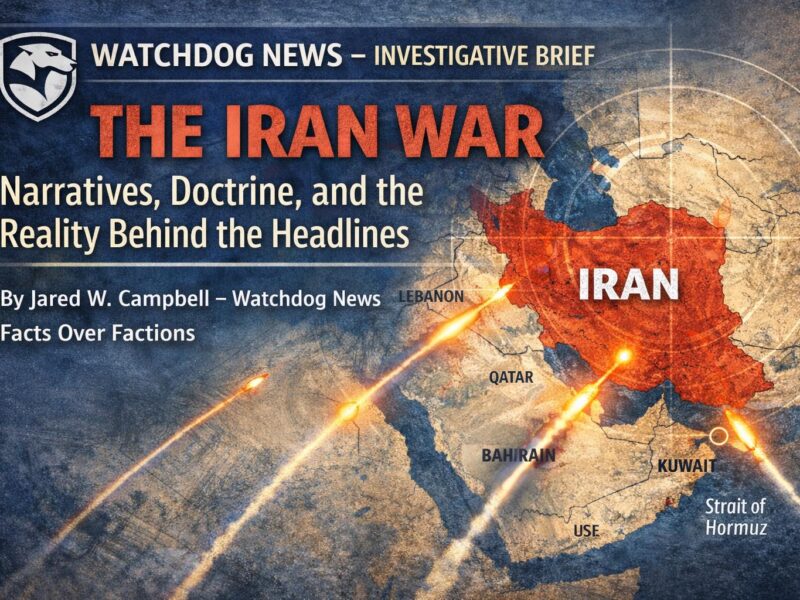
When “No More Wars” Meets Reality
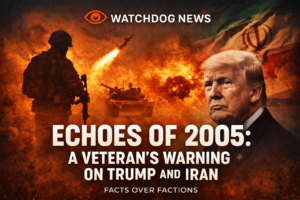
Trump, Iran, and the Echoes of 2005
By Jared W. Campbell — Watchdog News
Facts Over Factions
The Political Fracture Line
President Donald Trump ordered military strikes against Iran without formal congressional authorization, triggering immediate debate in Washington.
Democrats cite the War Powers Resolution and argue there was no “imminent threat” sufficient to bypass Congress.
Several Republicans — including Rep. Thomas Massie and Sen. Rand Paul — have also raised constitutional concerns.
Meanwhile, Republican leadership largely supports the action, calling it necessary for American security.
Polling data (Reuters/Ipsos) suggests:
- A majority of Americans oppose a broader war with Iran.
- Roughly one-quarter of Republican voters express discomfort with escalation.
This is not a simple left-versus-right debate.
It is an internal fracture within the movement that elected Trump.
The Strategic Justification
The administration’s position, articulated by Secretary of State Marco Rubio, is this:
- Intelligence indicated Israeli action was imminent.
- US forces would likely be targeted in retaliation.
- Acting first would reduce American casualties.
The White House has also cited concerns about Iran’s advancing military infrastructure and potential nuclear development.
In plain terms:
The administration argues that preemption prevents greater loss in the future
This logic is not new in American foreign policy.
The Veteran’s Concern
Here is where the Watchdog lens sharpens.
Many Americans — especially veterans — remember similar language:
- “We must act before the threat materializes.”
- “If we don’t fight them there, we’ll fight them here.”
- “This operation will be limited.”
- “We are ahead of schedule.”
Those phrases echo from 2003–2005 Iraq.
And for those who served, the echo is not theoretical.
It is personal.
🗣️ WATCHDOG OPINION
I Supported Trump — But I Recognize This Pattern
I believed him when he said:
“No more endless wars.”
“The Iraq War began in 2003. I went in 2005 — during the insurgency phase, when early confidence had already unraveled. I saw firsthand how fast “short and decisive” can become open-ended and costly. That experience is why I now pay attention to tone, language, and escalation signals. Wars rarely expand all at once. They drift.”
I believed America needed to stop destabilizing the Middle East.
But now I’m hearing the same messaging that sent me to Iraq in 2005.
I see the same urgency.
See the same certainty.
And the same moral framing.
The same belief that air power can reshape political outcomes.
History does not repeat word for word.
But it rhymes.
The Hard Question
Iran is not innocent.
It has supported militant networks.
And has destabilized parts of the region.
It has also opposed US interests for decades.
But the question is not whether Iran is problematic.
The question is:
Does escalation produce stability — or multiply instability?
Because I’ve seen what “limited war” turns into.
And so have millions of other veterans.
Constitutional Reality
Under the War Powers Resolution:
- The President can initiate hostilities.
- Sustained engagement beyond 60 days requires congressional approval.
This is not a minor procedural detail.
It is the constitutional guardrail meant to prevent drift into open-ended conflict.
When war expands without public debate,
the public eventually pays for it —
in blood, debt, or both.
The MAGA Divide
What makes this moment unique is not the Democratic opposition.
It is conservative opposition.
Libertarian Republicans argue:
- War expands government.
- War increases debt.
- War reduces civil liberties.
Some prominent voices within Trump’s coalition are warning:
Escalation could fracture the “America First” base.
That is politically significant.
The Strategic Reality
Here is the uncomfortable truth:
Air campaigns rarely produce regime change on their own.
Iraq.
Libya.
Kosovo required external political shifts.
Iran is a civilizational state of over 90 million people.
Removing leadership does not automatically remove cohesion.
And if regime change is not the objective,
Then what is the defined end state?
If the goal is deterrence,
How long is the campaign?
If the goal is collapse,
What replaces it?
These questions must be answered before escalation deepens.
The Emotional Layer
For those who served in Iraq and Afghanistan,
War is not abstract.
It is:
- friends lost
- marriages strained
- lives altered
- promises made and broken
When we hear language about quick victories and necessary strikes,
We don’t hear strategy first.
We hear memory.
And memory demands caution.
The Watchdog Position
My position is that this is not about hating Trump.
It’s not about loving Iran.
This is about pattern recognition.
A veteran can support a president —
and still question the road to war.
Those are not contradictions.
They are responsibilities.
The Real Test
If this remains:
- limited
- clearly defined
- constitutionally debated
- strategically contained
Then it may avoid becoming another generational war.
especially if it continues to drift,
and if rhetoric outruns planning,
Congress is sidelined,
escalation expands regionally —
Then history will not be kind.
Final Watchdog Reflection
Strength is not measured by how quickly we strike.
It is measured by:
- clarity of objective
- constitutional integrity
- strategic discipline
- willingness to pause before committing lives
I supported the promise of ending endless wars.
The question now is simple:
Are we keeping that promise —
Or repeating the cycle?
👁️ Jared W. Campbell
Watchdog News — Facts Over Factions