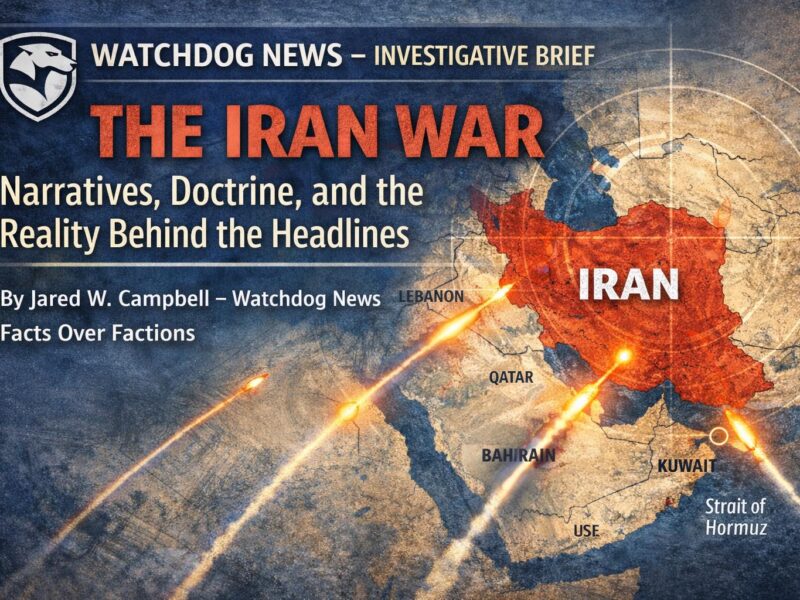


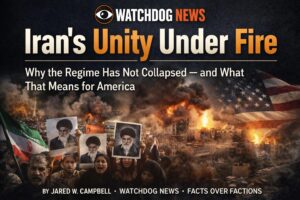
War often exposes the illusions nations tell themselves.
Many expected Iran to collapse under pressure.
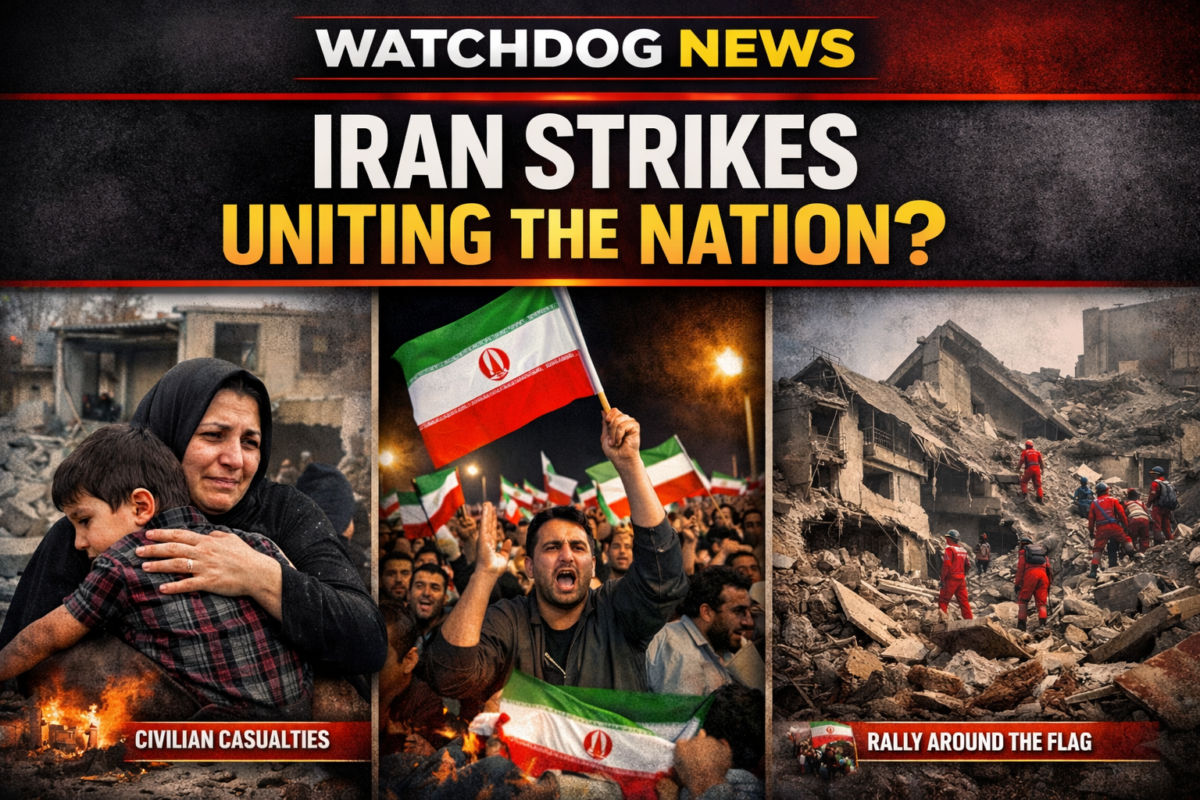
Instead, we are seeing something else: resilience, reorganization, and national unity under attack.
Facts Over Factions.

Iran’s Unity Under Fire- America’s Endless-War Problem
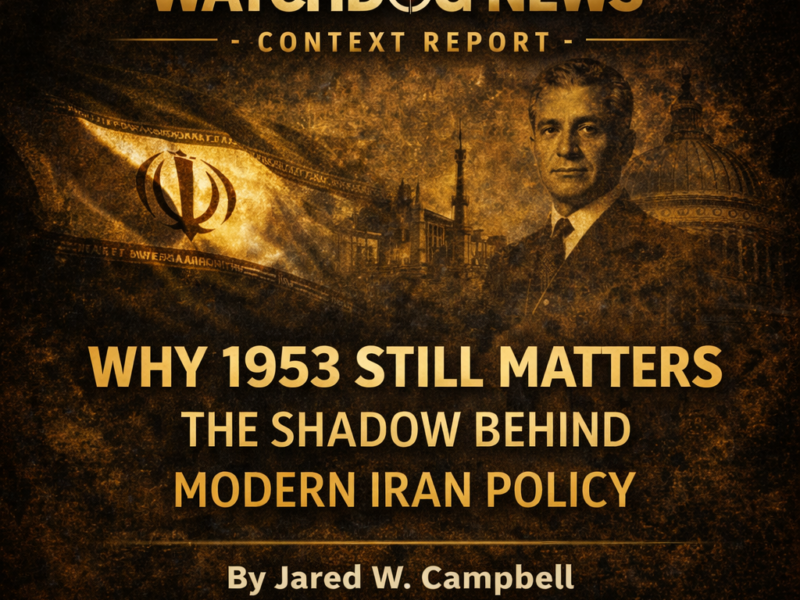
By Jared W. Campbell — Watchdog News
Facts Over Factions
War has a way of exposing illusions.
As a man of faith, as a combat veteran of the Iraq War, and as someone who has watched America stumble into one “limited operation” after another, I have learned to distrust easy narratives. I have seen what happens when Washington promises quick outcomes, moral clarity, and controlled escalation. I have seen what happens when political leaders speak in slogans while soldiers and civilians pay with their blood.
“That is why the question now matters: Why hasn’t Iran collapsed?”
That was clearly part of the expectation in much Western and Israeli commentary. Strike the leadership—Decapitate command. Break morale. Trigger uprisings. Open the door to regime change.
But that is not what appears to be happening.
“The deeper we dig, the clearer it becomes: the Iranian system was more resilient than many in Washington, Tel Aviv, and the Western media expected. And the reason is not a mystery. It is structure, doctrine, nationalism, memory, and the age-old reality that foreign attack often unifies a society that was divided the day before.”
That does not mean the Iranian regime is good.
From all reporting so far, we aren’t seeing any opposition inside Iran disappear.
However, this does not mean every Iranian supports the Islamic Republic.
It means something more serious:
A regime can be hated by many of its people and still become harder to overthrow once an outside power starts bombing the country.
That is a truth America should have learned already.
According to the Washington Post, six days into the campaign, there were still no significant defections, no mass uprisings, and no visible break in regime control, according to European, Arab, and US assessments cited in the report. The same reporting said Iran’s system had built layered replacement mechanisms and retained enough structure to retaliate quickly despite leadership losses.
That finding tracks closely with the RAND work you uploaded. RAND’s older but still highly relevant study on Iranian security policy describes Iran’s decision-making as “chaotic but not anarchic” and stresses that the system “emphasizes consensus,” keeps “most major players involved,” and usually prevents major actors from operating without higher approval. RAND’s later work on Iran’s national security debate makes the same point in more modern language: Western observers often imagine a simple top-down dictatorship, but in practice, Iran’s system is a bargaining process shaped by infighting, consensus-building, and red lines formalized by the supreme leader.
https://www.rand.org/pubs/research_reports/RRA444-2.html
That matters because systems built for continuity do not collapse just because outsiders kill senior leaders.
Iran isn’t bending. They are rerouting, replacing, and absorbing.
And that is exactly what outside reporting says Iran has been doing.
The Greek-language article from News 24/7, which drew on Washington Post reporting and regional official assessments, argued that Tehran’s “multi-layered system” enabled the immediate replacement of killed officials and preserved control even after devastating strikes. That article also noted that some Gulf officials had expected the assassination of the supreme leader to become an early turning point toward regime breakdown — but instead were surprised by the level of unity. That broad assessment aligns with the Washington Post’s reporting that the command structure was designed to survive precisely this kind of decapitation scenario.
There is another piece here that too many commentators miss: a foreign attack can override domestic fragmentation.
RAND’s 2001 study argued that Iran increasingly used ideology as a mask for realpolitik and that its security system balanced multiple factions through consensus, horse-trading, and overlapping institutions. That same study concluded that Iran’s security forces often prefer shows of force while seeking to avoid active confrontations, which helps explain why Tehran has historically favored calibrated pressure rather than suicidal conventional overreach.
https://www.rand.org/content/dam/rand/pubs/monograph_reports/MR1320/RAND_MR1320.pdf
In other words, the Islamic Republic is not built like a Hollywood villain’s lair. It is built like a regime that expects infiltration, crisis, decapitation attempts, protests, and siege.
That is one reason Larry Johnson’s central point in the interview you shared deserves serious attention, even if some of his battlefield claims remain hard to verify independently in real time: the attack may have unified Iran more than it weakened it.
That claim is not just pundit talk. RAND testimony from Ariane Tabatabai noted that the regime had already demonstrated a new capability to completely shut down the internet, specifically to contain dissent, control information flows, and limit outside reaction. If a state can both preserve internal command and suppress information during a crisis, outside analysts will naturally struggle to gauge the country’s true condition.
https://www.rand.org/content/dam/rand/pubs/testimonies/CT500/CT522/RAND_CT522.pdf
That means two things can be true at once:
First, Iran may be suffering real damage.
Second, outside observers may still badly misread the political effect of that damage.
That brings us to one of the most important distinctions in this war: regime resilience is not the same thing as popular love.
The Iranian opposition has not disappeared. In the Greek piece on the “X factor” of Kurdish resistance, the author argued that many Iranians still want regime change and a democratic future, while also distrusting a U.S.-Israeli war plan, distrusting restoration of the Shah’s family, and rejecting the idea of trading one externally managed order for another. In that telling, the issue is not whether there is opposition; it is whether bombing and foreign-backed alternatives have any legitimacy within the country. That is a crucial distinction. The absence of revolt after a foreign attack does not prove loyalty to Tehran. It may reveal the attackers’ distrust.
And history supports that reading.
RAND’s 2021 report on Iranian military interventions found that, outside the Iran-Iraq War, Iran has generally shown a high threshold for deploying ground troops in combat, preferring instead to work “by, with, and through proxies” to project power at lower cost, avoid backlash, and keep itself from being stretched too thin. That pattern reinforces the broader picture: Iran’s leaders think in terms of endurance, layered deterrence, and indirect conflict — not fragile dependence on a single chain of command or charismatic leader.
So when Johnson argues that the planners behind this war misread Iran’s social fabric, that claim aligns with the RAND literature more than many people realize.
Where I would apply the Watchdog brake is on some of the more specific battlefield assertions from the interview. Claims about multiple false flags in Saudi Arabia, Azerbaijan, Turkey, and Cyprus, or precise counts of Patriot and THAAD depletion, or exact numbers of downed aircraft, are the kind of claims that can circulate fast during wartime and require much stronger independent confirmation than is currently available in the sources we’ve reviewed. The same goes for his more dramatic statements about imminent total missile exhaustion or exact behind-the-scenes coordination among regional players. Those points may prove partly right, partly wrong, or impossible to verify. A Watchdog has to separate structural insight from unverified detail.
But on the larger strategic question — did the attack fracture Iran, or consolidate it? — The available evidence points in one direction.
Even critical outside reporting now acknowledges that the regime remains in control. The Washington Post reported no major defections or uprisings and described internal security organs such as the Basij and the police as still operating. The New Yorker similarly warned that attacks may be hardening Iranian unity instead of producing collapse, with nationalism and survival instincts taking precedence over prewar divisions.
There is also the moral dimension.
Reuters reporting, carried by multiple outlets, says US investigators now believe it is likely that US forces were responsible for the Minab girls’ school strike. However, no conclusion has been reached. The Pentagon has acknowledged an investigation, Reuters could not independently confirm the death toll claimed by Iran, and UN hUN rights officials have called for an investigation. If that reporting is ultimately confirmed, then the political effect inside Iran should surprise no one. Civilian blood, especially children’s blood, rarely invites a democratic transition. It invites rage, grief, and hardening.
The Pentagon referred Reuters’ questions to United States Central Command, whose spokesman, Captain Timothy Hawkins, said: ” It would be inappropriate to comment, given that the incident is under investigation.”
The White House did not immediately comment on the investigation. Still, spokeswoman Karoline Leavitt told Reuters: “While the Department of War is currently investigating the matter, it is the Iranian regime that is targeting civilians and children, not the United States of America.”
When asked about the incident at a press briefing on Wednesday, Hegseth said: ” We are investigating it. Of course, we never target political targets. But we are looking into it and investigating it.”
US Secretary of State Marco Rubio told reporters on Monday that the United States would not intentionally target a school.
” The War Department would investigate if it were our blow, and I would refer you to them for your question,” Rubio said.
Israeli and American forces have so far divided their strikes on Iran both geographically and in terms of the types of targets, according to a senior Israeli official and a source with direct knowledge of the joint planning. While Israel has been striking missile launch sites in western Iran, the United States has been striking similar targets as well as naval targets in the south of the country.
The United Nations human rights office, without saying who it holds responsible for the attack on the school, called for an investigation on Tuesday.
” The responsibility lies with the forces that carried out the attack to investigate it,” UN human rights office spokeswoman Ravina Shamdasani said at a press briefing in Geneva.
Images from the girls’ funeral on Tuesday were broadcast on Iranian state television. The small coffins, draped in Iranian flags, were carried by a truck through a large crowd to the burial site.
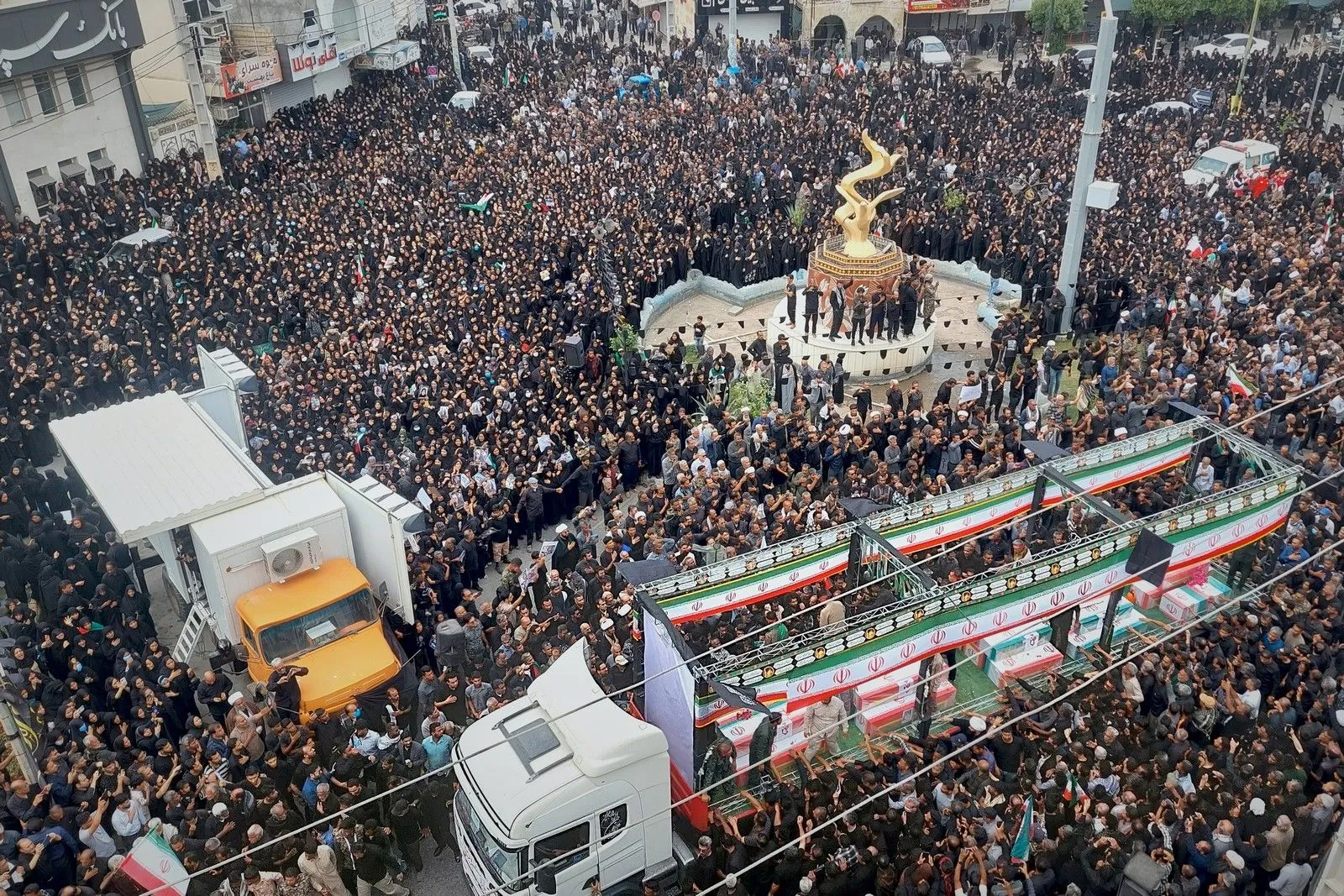
Deliberately attacking a school, hospital, or any other civilian infrastructure could be considered a war crime under international humanitarian law.
If American involvement is confirmed, the strike could be among the worst civilian casualties in decades of American conflicts in the Middle East.
And that hardening matters not just for Iran, but for America.
As an Iraq veteran, I cannot read this without hearing echoes of our own past. America has a pattern: overestimate the political effect of air power, underestimate the enemy’s social cohesion, assume regime change is easier than it is, and treat endless war as something that happens on a map rather than in real human lives. RAND’s 2013 report on a possible nuclear-armed Iran described the Islamic Republic as “revisionist yet restrained,” a formulation that matters because it challenges the lazy caricature of Iran as either irrationally suicidal or easily cowed. f you misunderstand an adversary’s restraint, nationalism, and survival instincts, you will miscalculate — and miscalculation is how endless wars begin.
That is the real Watchdog warning here.
The issue is not whether the Iranian regime is righteous.
It is not.
The issue is not whether many Iranians want change.
Many clearly do.
The issue is whether outside military violence is producing the political effect its planners expected.
So far, the answer appears to be no.
The Watchdog sees no collapse; we are seeing resilience.
No panic on the Watchdog’s side, we are seeing reorganization.
Instead of a clean regime-change arc, we may be seeing the old American disease return: another war entered with confidence and continued with no credible political end state.
A wise nation should learn from that.
A humble nation would learn faster.
👁️ Watchdog Closing Statement
The deeper lesson of this war is not that Iran is invincible. It is that nations under attack often become more unified than their enemies expected — especially when outsiders mistake internal dissent for readiness to submit.
Here at Watchdog News, we make no excuses for Tehran.
We don’t romanticize resistance.
Truth doesn’t repeat propaganda just because it wears an American flag.
The Watchdog follows the evidence.
And right now, the evidence suggests that America and Israel may have badly misread the political battlefield inside Iran — the very kind of misreading that has fed endless wars for a generation.
Jared W. Campbell
Watchdog News — Facts Over Factions

— Watchdog News
👁️ Facts Over Factions