


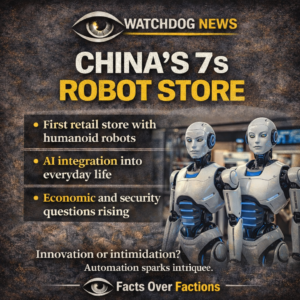
“Humanoid Robots Go Retail — Innovation, Competition, and the Bigger Question Behind China’s 7S Robot Store.”
By Jared W. Campbell — Watchdog News
Facts Over Factions | Different Perspectives | Strategic Context
Powerful Introduction — Why This Story Matters
Every technological headline looks harmless at first.
A new gadget.
A new store.
An innovation milestone.
But history teaches something important:
Major geopolitical shifts rarely begin with weapons — they begin with industry.
Railroads reshaped empires.
Oil reshaped wars.
The internet reshaped power itself.
Now the question facing the world is this:
Are humanoid robots becoming the next strategic frontier?
China’s opening of the first 7S humanoid robot retail store may sound like a novelty story — dancing robots in a storefront —, but through a Watchdog lens, this is not just retail.
It’s a signal.
✅ 1) What Is Verified (Facts)
According to the reporting:
-
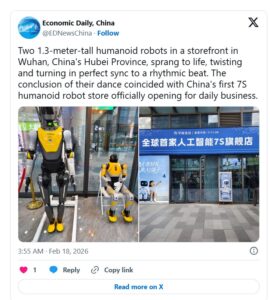
China has opened the first operational “7S humanoid robot store” in Wuhan, Hubei Province.
-
The store functions similarly to a 4S automobile dealership model, offering:
-
Sales
-
Technical servicing
-
Spare parts
-
Operational support
-
Application deployment for robots
-
-
The Hubei Humanoid Robot Innovation Center operates the storer.
-
The location sits in Wuhan’s East Lake High-Tech Development Zone (“Optics Valley”), a major Chinese technology hub.
-
Robots approximately 1.3 meters tall were activated publicly as part of daily operations.
This confirms something important:
👉 China is moving humanoid robotics from research labs into commercial ecosystems.
2) Why Analysts Are Paying Attention
This is not occurring in isolation.
China has already invested heavily in:
-
AI manufacturing automation
-
Robotics supply chains
-
Semiconductor independence
-
Smart factories and logistics automation
Humanoid robots represent the next stage in integrating AI and physical labor.
Instead of robots confined to factories, the goal appears to be:
-
Service-sector automation
-
Retail interaction
-
Elder care assistance
-
Logistics and maintenance roles
-
Industrial adaptability
In other words:
Robots designed to operate in human environments — not just assembly lines.
3) The Strategic Perspective (Different Viewpoints)
Perspective A — Technological Innovation
Supporters see this as:
-
A natural evolution of robotics.
-
A response to aging populations and labor shortages.
-
Economic modernization is similar to past waves of automation.
China faces demographic decline — fewer young workers entering the workforce — making automation economically logical.
From this angle:
👉 Humanoid robots are productivity tools, not geopolitical instruments.
Perspective B — Economic Competition
Western analysts increasingly frame robotics as part of the U.S.–China technological rivalry.
Why?
Because whoever leads in humanoid robotics could control:
-
Manufacturing efficiency
-
AI hardware deployment
-
Global industrial standards
-
Future labor economics
Just as smartphones reshaped global markets, humanoid robotics could reshape labor itself.
If China dominates production:
-
Costs fall globally.
-
Adoption accelerates.
-
Dependency risks emerge for importing nations.
Perspective C — Security & Dual-Use Concerns
Here’s where Watchdog questions begin.
Humanoid robotics technology overlaps with:
-
Military logistics automation
-
Surveillance integration
-
Disaster response systems
-
Autonomous operational support
Most advanced technologies historically become dual-use:
Internet → civilian + military
GPS → civilian + military
Drones → civilian + military
Humanoid robotics may follow the same pattern.
Not necessarily weaponization — but strategic capability expansion.
4) Why Wuhan Matters
Wuhan is not a random location.
It is:
-
One of China’s largest industrial innovation zones.
-
A government-supported technology cluster.
-
A center for optics, AI, and robotics research.
China’s industrial policy often follows a pattern:
-
State-supported innovation hubs
-
Pilot commercialization
-
Domestic scaling
-
Global export dominance
The 7S store fits step two — commercialization.
5) The Western Contrast
While China opens retail robot ecosystems, Western development is more fragmented:
-
U.S. innovation led by private firms (Tesla Optimus, Boston Dynamics, Figure AI).
-
Europe focused on regulatory frameworks.
-
Slower commercialization pipelines.
Different systems produce different speeds:
-
Central planning → rapid deployment.
-
Market-driven innovation → slower rollout but higher diversity.
Neither is automatically “better,” but the timelines differ.
6) Watchdog Questions That Matter
Instead of hype or fear, objective reporting asks:
-
Are these robots economically viable or symbolic demonstrations?
-
Who controls the software ecosystems behind them?
-
Will global supply chains depend on Chinese robotics manufacturing?
-
How will labor markets react if humanoid automation becomes affordable?
-
Is this consumer tech — or infrastructure for future AI economies?
7) The Bigger Picture — Not a Gadget Story
Humanoid robots represent something deeper:
The merging of AI intelligence with physical capability.
That changes:
-
Work
-
Security
-
Economics
-
Global competition
The Industrial Revolution replaced muscle.
The AI revolution may replace routine decision-making.
Humanoid robotics combines both.
👁️Watchdog Conclusion
Through a Watchdog lens, this story isn’t about dancing robots in a window.
It’s about trajectory.
China is signaling a future in which robots are no longer experimental — they are commercial, serviceable, and integrated into daily life.
The real question isn’t:
“Are robots coming?”
They already are.
The real question is:
👉 Who shapes the rules, standards, and power structure of an automated world?
Because technological leadership has always translated into geopolitical influence.
And history shows — whoever industrializes first often writes the next chapter of global order.
Watchdog Standard:
Ask questions.
Check narratives.
Follow capability — not headlines.
👁️ Facts over factions.