

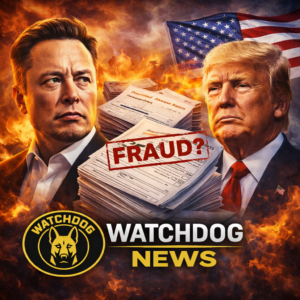
👁️— Watchdog News
Facts Over Factions
Georgia Election Investigation — What Was Found, What Wasn’t, and What’s Being Framed
By Jared W. Campbell — Watchdog News
Facts Over Factions
1️⃣ What is actually verified
The Georgia election regulators investigated political mailers linked to absentee ballot applications during the 2024 election cycle.
Key verified elements reported across multiple outlets and election filings:
-
Political organizations — including America PAC, a pro-Trump political action committee associated with Elon Musk’s political spending network — sent absentee ballot application mailers to voters.
-
Georgia law places restrictions on how third parties distribute or assist with absentee ballot materials.
-
The Georgia State Election Board reviewed whether the mailings complied with disclosure and formatting rules.
-
Officials determined certain mailers were improperly formatted or insufficiently labeled as unofficial election materials.
The publicly reported enforcement action was administrative, not criminal.
👉 Important distinction: regulators addressed mailing compliance, not ballot manipulation.
2️⃣ What the investigation did NOT find
Across reporting from election officials and state records:
-
❌ No evidence that ballots were altered
-
❌ No proof votes were changed
-
❌ No evidence of forged ballots
-
❌ No coordinated vote-count fraud
The issue centered on election communication rules, not vote tampering.
That matters because “voter fraud” has a specific legal meaning — and regulators did not classify the incident as election fraud affecting vote totals.
3️⃣ Legal context — why this matters in Georgia
Georgia tightened election laws after 2020, including rules governing:
-
Third-party absentee ballot outreach
-
Pre-filled voter information
-
Required disclaimers on election mailers
The concern regulators often cite is voter confusion:
If a mailing looks official, voters may believe it came from the government rather than a political organization.
Election boards across parties have historically penalized both Democratic and Republican groups for similar disclosure violations.
This places the issue closer to:
👉 campaign compliance enforcement
rather than systemic election interference.
4️⃣ The competing narratives
Narrative A — Critics’ view
Some commentators argue:
-
Billionaire-funded political operations are influencing elections through aggressive outreach tactics.
-
Poorly labeled mailers risk misleading voters.
-
Enforcement shows election manipulation concerns apply to all political actors, not just one side.
Their argument: election integrity must apply universally.
Narrative B — Supporters’ view
Defenders of the PAC argue:
-
Political groups across the spectrum routinely send absentee ballot applications.
-
Administrative violations are common in modern campaigns.
-
Calling this “voter fraud” exaggerates a technical compliance issue.
Their argument: this is regulatory enforcement being politically framed.
5️⃣ What major election experts say
Election law analysts generally distinguish three categories:
| Category | Meaning |
|---|---|
| Administrative violation | Paperwork or disclosure errors |
| Election interference | Attempts to influence voters legally or illegally |
| Voter fraud | Illegal manipulation of actual votes |
Atlanta Journal-Constitution (AJC)
Coverage of Georgia election enforcement has repeatedly emphasized that violations of absentee-ballot outreach typically fall under disclosure rules rather than fraud statutes.
Election officials noted that enforcement actions are meant to prevent voter confusion when mailers resemble official government documents.
Reuters
Reporting on election administration cases nationwide has consistently distinguished between:
“administrative election violations and fraud involving illegal voting activity.”
(Reuters election integrity coverage, 2024–2025 reporting series)
Associated Press
AP election guidance reporting explains that third-party absentee ballot campaigns are common across both parties, but must include clear disclaimers so voters understand they are political communications.
AP notes:
“Outside groups may distribute applications but cannot misrepresent them as official election materials.”
Most reporting places this case in Category 1.
6️⃣ The Watchdog question: Why this framing now?
This is where Watchdog reporting steps back.
The timing matters because:
-
Election integrity narratives remain politically powerful post-2020.
-
Both parties increasingly accuse the other of undermining democracy.
-
Stories confirming wrongdoing — even minor — are quickly amplified to validate broader political claims.
In other words:
👉 The same event becomes proof of corruption or proof of overreaction, depending on who tells the story.
7️⃣ What remains unclear
Key unanswered questions:
-
How many mailers were distributed?
-
Were voters demonstrably confused?
-
Were similar violations pursued equally across parties?
-
Will enforcement standards remain consistent moving forward?
🧭 Watchdog Conclusion
The Georgia investigation did find regulatory violations tied to absentee ballot mailings, including issues involving a pro-Trump PAC connected to Elon Musk’s political spending network.
But current public evidence does not show vote manipulation or election fraud affecting results.
The real story is less dramatic — and more revealing:
Modern elections are increasingly fought through legal gray zones of messaging, outreach, and perception, where administrative violations can quickly become political weapons.
A Watchdog doesn’t chase headlines.
A Watchdog asks:
Are we uncovering corruption — or watching narratives compete for legitimacy?
Jared W. Campbell — Watchdog News
Facts Over Factions