

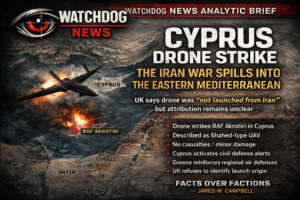
A drone strike on RAF Akrotiri in Cyprus may look like a minor incident.
But the bigger story is attribution.
Modern war is no longer just about missiles and drones — it is about narrative control, escalation management, and strategic ambiguity.
The Iran conflict may now be creeping into the Eastern Mediterranean.
Facts Over Factions.
Cyprus Drone Strike: Attribution Games in the Iran War’s Eastern Mediterranean Spillover
By Jared W. Campbell — Watchdog News
Facts Over Factions
Why This Matters
A recent drone strike on RAF Akrotiri in Cyprus has been downplayed in the media as a minor incident, with claims of minimal damage and no casualties. However, the implications of this event are anything but trivial.
The conflict involving Iran is now creeping closer to vital European interests in the Eastern Mediterranean. We need to recognize that modern warfare transcends just the use of missiles and drones; it weaves in layers of attribution, messaging, and the delicate dance of escalation control.
Understanding who launched the attack is important, but even more critical is grasping who will shoulder the blame. This nuance can shape the narrative and direction of future confrontations.
1) What We Can Say With Confidence
In a concerning development, a one-way attack drone targeted RAF Akrotiri during the late hours of Sunday night, extending into the early hours of Monday local time.
British sources have verified several key points regarding this incident:
– Fortunately, there were no casualties reported among the personnel stationed at the base.
– Although the impact resulted in some minor material damage to the infrastructure, the situation has been managed efficiently, minimizing any potential disruptions.
– The rapid response of defense forces led to the successful interception of several additional drones that were identified in the vicinity, mitigating further risks.
In the wake of this event, the leadership of Cyprus has publicly characterized the downed aircraft as a Shahed-type uncrewed aerial vehicle (UAV). The incident has been regarded with significant gravity, prompting the Cypriot government to treat it as a matter of national security. As a result, the National Security Council convened an emergency meeting, and government services have been placed on heightened alert to ensure the region’s safety and security. This underscores the authorities’ seriousness about potential threats to their national integrity and the importance of coordinated defensive measures. These confirmed aspects of the event have garnered attention from both military and diplomatic circles.
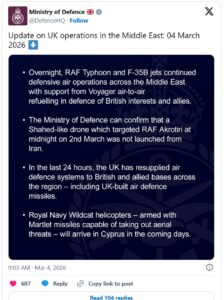
Update on UK operations in the Middle East: 04 March 2026 ⬇️
2) Headline Conflict: “Shahed-Type” vs “Not From Iran.”
The narrative surrounding the drone incident presents two conflicting perspectives. Officials from Cyprus described the drone as a Shahed-type platform, a model commonly associated with Iranian drone technology. In contrast, the British Ministry of Defence asserted that the drone was not launched from Iran.
It is important to note that the statement did not claim the drone did not involve Iranian technology, only that it did not originate from Iranian territory. Current Western reporting is exploring the possibility of a proxy launch, potentially from areas controlled by Hezbollah in Lebanon or from militia-held regions in Syria.
Watchdog Takeaway: Understanding the Dynamics of Modern Warfare
“Shahed-type” encapsulates a design lineage—this is not up for debate. In the realm of modern warfare, it’s crucial to recognize that Design does not equal Launch Origin, and Command Authority is distinct. These distinctions are often purposefully obscured.
This blurred landscape is precisely where information warfare takes place. We must navigate this gray area with clarity and precision to understand the true mechanics of contemporary conflict. Ignorance is not an option; we need to confront these complexities head-on.
3) Cyprus’ Posture: “We Are Not Part of This.”
(But Preparing As If We Might Be)
Cyprus President Nikos Christodoulides stated that the island does not participate in any military operations and has no intention of becoming involved in any. This statement reflects a common strategy among small states located near major conflicts, which often publicly signal neutrality despite the presence of large military powers operating bases within their territory.
In conjunction with this stance, Cyprus has begun expanding its civil defense readiness, which includes:
– Nationwide emergency SMS alert testing
– Public guidance on sheltering
– Instructions for civilian preparedness
Watchdog Read: A Lesson in Geography and Crisis
This is a classic case of small-state crisis behavior. It’s all about maintaining a facade of public neutrality while gearing up behind the scenes. When you find yourself nestled between launch corridors and military installations, it’s not just your intentions that matter; it’s the sheer force of geography that can drag you into the fray. Understanding this dynamic is crucial for navigating complex international tensions.
4) Greece’s Angle: Deny Rumors, Harden Defenses
Greek Defense Minister Nikos Dendias promptly addressed and dismissed rumors that drones were heading toward Souda Bay in Crete. He confidently asserted that Greece’s advanced radar systems are fully capable of detecting any such launches well before they could pose a threat.
In light of ongoing regional tensions, Greece has taken proactive measures to bolster its security posture. This includes the strategic deployment of additional naval assets, the mobilization of fighter aircraft, and enhanced air defense coverage that specifically supports Cyprus.
Souda Bay, given its strategic importance as a NATO and U.S. naval hub, stands out as a potential target amid escalating regional conflicts. Its importance for logistics and military operations underscores the necessity for Greece to maintain vigilant defensive capabilities in the area.
“We have taken our measures, I assure you.”
When asked what the response would be if there were a strike on Greek soil, he said laconically: “We have taken our measures, I assure you,” clarifying that he would not deviate into further discussion.
Mr. Dendias, however, did not enter into the discussion about what the next day in Iran would be like. “The global television map is full of analysts. We don’t need another one,” he commented, smiling.
“I can’t predict what will happen in Iran. A large part of the Iranian leadership is not alive. I can’t predict what I can, but I have an obligation to protect our homeland,” he added.
The Minister of Defense even commented that: “Today it is proven how right we were to turn to systems for the comprehensive protection of Greek territory, which we have called Achilles’ shield .”
“The safety of our staff always comes first.”
He confirmed that France is considering sending a frigate to the Strait of Hormuz. He recalled that the Greek Navy already has a presence in the region with the frigate Hydra in Djibouti, “precisely to protect the routes of communication and the interests of Greece and Greek shipping,” and added:
“If there is a European operation, we will see, but we will weigh the risk and the danger for the Navy .” He also clarified that: “The safety of the personnel always comes first for us.”
Asked whether Greece would participate in a multinational NATO force in Iran with ships, if requested, Mr. Dendias replied: “I cannot rule out anything, but I cannot agree to anything either. However, we are very far from that at the moment.”
He even noted that: “It is not easy. The area has difficulties near Iran. There are many issues that anyone considering this operation must solve,” and stated: “I am not ready to put the Navy’s personnel in danger if this risk is not calculated and their lives are not adequately protected.”
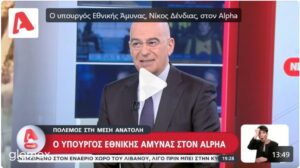
Dendias refutes Koutsoumbas about drones against Soudas https://www.alphatv.gr/news?utm_source=glomex.
Watchdog Read
When officials state, “we would have seen it,” this language effectively serves two key purposes:
1. It reassures the public.
2. It sends a strong signal of deterrence.
“In a conflict environment where misinformation can spread more rapidly than interceptors, governments must act decisively to prevent rumor escalation from turning into real conflict.”
- The Watchdog
5) UK Messaging: A Careful Balancing Act
The United Kingdom is navigating a precarious path with its messaging. Official statements emphasize the following points:
– Minimal damage
– No casualties
– A defensive posture
“Importantly, British officials have been careful not to characterize the event as an act of war. At the same time, reports indicate that the UK is enhancing its defensive posture around Cyprus, which includes bolstering naval and air defense assets.”
This is a clear example of escalation management:
• Avoiding war rhetoric → reduces pressure for retaliation
• Enhancing defenses → minimizes vulnerability
• Maintaining flexible options → sustains deterrence
6) The Information Warfare Signature
This entire situation bears the hallmarks of modern information warfare.
A) Strategic Ambiguity
“Not from Iran.”
However, no specific origin is mentioned.
This omission is not accidental.
Identifying the launch location or the responsible actor could lead to escalation pathways that governments may not want to pursue at this time.
Maintaining ambiguity allows for greater diplomatic flexibility.
B) Timing Narratives
Some reports suggest the launch occurred before certain Western policy announcements. This framing serves as a narrative shield, countering the claim that the strike was a direct act of retaliation.
C) Civil Defense Messaging
When Cyprus activates national emergency alerts and shelter messaging, it sends two important signals:
public safety preparation and the acknowledgment that the island may now be within a potential strike envelope.
D) Competing Media Frames
Right now, three major narrative frames are circulating:
Regional media frame:
“War spillover into Europe.”
British government frame:
“Limited incident, defensive posture.”
Wire-service frame:
“Attribution unclear, proxies likely.”
The Government of Cyprus is launching a new messaging system today to provide citizens with important information during potential security incidents. This initiative, in partnership with all telecommunications providers, aims to help people understand what actions to take as advised by Civil Defense.
At around 7:00 p.m. today, a test of this service will take place. A test message will be sent to all mobile phone users in Cyprus to ensure the system works properly.
The Watchdog Principle
When conflicting narratives clash, the truth often emerges from the shared ground in between. Consider this scenario:
– A drone strike took place.
– The source of the strike remains hotly debated.
– Governments are carefully managing the language surrounding escalation.
In the midst of this turmoil, the real story is waiting to be uncovered.
7) The Most Likely Scenario
Based on reporting from various outlets, the prevailing hypothesis suggests the following points:
– An Iranian-lineage drone platform
– is launched by a proxy actor operating in nearby territory, often identified as Lebanon/Hezbollah
– and aims to demonstrate a signal of reach rather than indicate a confrontation between Iran and the UK.
This does not imply that Iran has no involvement, but rather that the command-and-control chain remains intentionally unclear.
8) What To Watch Next
To stay grounded in Facts Over Factions, focus on verification triggers over speculation. Key indicators will guide us:
• Forensic analysis of drone fragments
• Shifts in official attribution language
• Repeat drone attempts against Eastern Mediterranean targets
• Stories of air defense reinforcements
• Civil aviation disruptions linked to suspected drone activity
“These developments will illuminate whether this incident stands alone, because it seems it heralds the beginning of a broader pattern.”
WATCHDOG CLOSE
Cyprus states, “We are not involved in this.”
Britain adds, “Not from Iran — we have no further details.”
Greece responds, “We would have detected it.”
These statements do not contradict one another; they actually rhyme. This illustrates the nature of modern warfare, where the information domain is as contested as airspace. Attribution becomes a weapon, and at times, silence serves as a strategy.
Jared W. Campbell- Watchdog News
Facts Over Factions.

Watchdog News Original Logo