

A growing number of veterans are asking a difficult question:
Should someone lose their Second Amendment rights simply for using medical cannabis legally under state law?
As federal courts and the Supreme Court examine the issue, the debate is no longer theoretical—it’s personal.
Facts Over Factions

Cannabis, the Second Amendment, and the Question Many Veterans Are Asking
By Jared W. Campbell — Watchdog News
Facts Over Factions
There are moments when a national debate stops being theoretical.
It becomes personal.
For many Americans—especially veterans—the debate surrounding cannabis and gun rights has reached that point. Across the country, former soldiers, law-abiding citizens, and medical patients are asking a simple question that Washington has struggled to answer clearly:
Should someone lose their Second Amendment rights simply for using cannabis—even legally under state law—if they have never committed a crime or shown violent behavior?
As a combat veteran of the Iraq War who uses medical cannabis, I take this question seriously—not just politically, but personally. The Watchdog approach demands that we examine the facts, the law, and the arguments on both sides without falling prey to slogans.
Because, like many modern American issues, the truth is more complicated than the talking points.
The Federal Law at the Center of the Debate
At the heart of this issue is federal firearms law, specifically 18 U.S.C. §922(g)(3).
Under that law, it is illegal for anyone who is an “unlawful user of or addicted to any controlled substance” to possess a firearm.
The complication is simple:
Cannabis remains classified as a Schedule I drug under the federal Controlled Substances Act—even though dozens of U.S. states have legalized marijuana for medical or recreational use.
That means that under federal law, a person using marijuana—even legally under state law—can technically be considered an “unlawful user.”
The federal firearm purchase form, ATF Form 4473, makes this explicit. It warns gun buyers that marijuana remains illegal under federal law, regardless of state legalization.
Source:
ATF Firearms Transaction Form 4473

ATF Firearms Transaction Form 4473 (f)
For years, that federal classification has created a strange contradiction:
A veteran can legally use medical cannabis under state law, yet simultaneously be prohibited from owning a firearm under federal law.
Why This Issue Has Reached the Supreme Court
The legal conflict is now moving toward the country’s Court.
The Supreme Court recently heard arguments regarding the constitutionality of this federal gun ban as it applies to marijuana users. According to reporting from Reuters, several justices appeared skeptical of the government’s defense of the law.
Source:
Reuters — Supreme Court questions gun ban for marijuana users
The central constitutional issue stems from the Court’s 2022 Bruen decision, which reshaped Second Amendment jurisprudence.
Under the Bruen framework, firearm restrictions must be consistent with the historical tradition of gun regulation in the United States.
That raises an uncomfortable question for the federal government:
Is there a historical tradition of disarming citizens merely for using a substance like cannabis?
So far, the answer appears far from clear.
https://www.thetrace.org/2024/09/bruen-ruling-scotus-second-amendment-gun/#:~:text=The%20Bruen%20decision%20recognized%2C%20for,how%20to%20apply%20the%20ruling.
The Public Health Argument
Supporters of the federal law argue that firearm ownership should be restricted for individuals actively using intoxicating substances.
Their reasoning is straightforward: impairment combined with firearms could create dangerous situations.
The U.S. Department of Justice has defended the law partly on those grounds.
But the debate becomes more complicated when examining actual public-health data.
Research from the National Institute on Drug Abuse (NIDA) indicates that approximately 9% of cannabis users develop cannabis use disorder—a rate that is widely cited in addiction studies. While this is just one study, see the screenshot because there is mixed information as far as research; some sources’ addiction rate could be higher depending on the age and group of individuals who use cannabis.

screenshot
Source:
National Institute on Drug Abuse
https://nida.nih.gov/research-topics/cannabis-marijuana
That figure is notable because it is significantly lower than addiction rates associated with several legal substances, including nicotine and alcohol.
Yet Americans who consume alcohol—millions of them—do not automatically lose their Second Amendment rights.
That inconsistency has become one of the most frequently cited criticisms of the federal cannabis firearm ban.
Veterans and Medical Cannabis
This issue resonates particularly strongly in the veteran community.
According to the U.S. Department of Veterans Affairs, many veterans report using cannabis to manage conditions such as PTSD, chronic pain, and sleep disorders, especially in states where medical marijuana is legal.
Source:
U.S. Department of Veterans Affairs — Cannabis Research
https://www.hsrd.research.va.gov/publications/forum/spring20/default.cfm?ForumMenu=spring20-5
https://www.hsrd.research.va.gov/publications/esp/cannabis.cfm
The Department of Veterans Affairs itself does not prescribe cannabis due to federal restrictions. Still, VA doctors are permitted to discuss cannabis use with patients in states where it is legal.
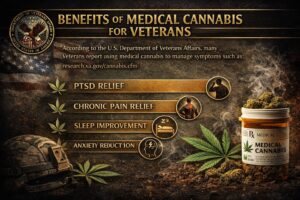
Benefits of Medical Cannabis for Veterans
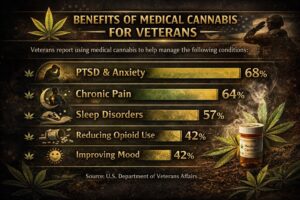
Benefits of Medical Cannabis for Veterans
This has created another paradox:
A veteran may openly discuss cannabis use with a VA physician while simultaneously facing potential federal firearm restrictions for the same behavior.
The Constitutional Question
The broader constitutional debate centers on a simple principle:
Should constitutional rights be removed without evidence of dangerous behavior?
Critics of the current law argue that the federal ban treats all cannabis users the same, regardless of their personal conduct.
Someone who smokes marijuana occasionally under state-legal medical supervision may be treated the same under federal firearms law as someone addicted to hard drugs.
Supporters of the law counter that Congress has the authority to regulate firearms in the interest of public safety, especially when controlled substances are involved.
Both arguments exist in good faith.
But the tension between federal drug policy and state legalization has pushed the legal system toward a crossroads.
A Nation Divided on Cannabis Policy
Public attitudes toward marijuana have shifted dramatically over the last two decades.
According to the Pew Research Center, a large majority of Americans now support some form of marijuana legalization.
Source:
Pew Research Center — Marijuana legalization trends
https://www.pewresearch.org/short-reads/2025/07/08/facts-about-marijuana/
Yet federal law has not fully caught up with those changes.
Cannabis remains federally illegal, even as most states have legalized it in some form.
That disconnect between federal law and state law is now colliding with the Second Amendment.
The Watchdog Question
A Watchdog does not start with ideology.
A Watchdog starts with a question.
If a peaceful citizen—especially a veteran—has never committed a crime, never threatened anyone, and lives under state laws that permit medical cannabis use, should that person automatically lose their constitutional right to own a firearm?
That question is not hypothetical anymore.
It is being argued in federal courts right now.
And the Supreme Court may soon decide how far the federal government can go when drug policy collides with the Second Amendment.
The Watchdog View
The easiest answers in this debate are the loudest ones.
One side claims cannabis users are dangerous and must be disarmed.
The other claims the government has no role at all in regulating firearms among people who use intoxicating substances.
The truth—like most serious national questions—lies somewhere between those extremes.
Cannabis is not harmless.
But neither does the evidence support treating every cannabis user as a public safety threat.
The Constitution was written with the understanding that rights belong to the people—not just to those the government considers ideal citizens.
And if a constitutional right can be suspended automatically because of a substance many states now consider legal, then Americans should at least have an honest national conversation about whether the law still reflects reality.
That conversation is happening now.
And like many debates in modern America, the outcome will shape far more than one issue.
👁 Watchdog Note
When laws written for one era collide with the realities of another, the result is confusion, contradiction, and constitutional tension. The cannabis and firearms debate is not simply about drugs or guns—it is about how a nation balances liberty, safety, and evolving public policy.
A Watchdog’s duty is simple:
“Follow the facts. Question the assumptions. Protect the truth.”
— Jared W. Campbell
Watchdog News
Facts Over Factions