

The War Behind the War: Internal Fracture, Intelligence Dispute, and the Quiet Opening of the Iraq Front
Tuesday, March 17, 2026
By Jared W. Campbell — Watchdog News
👁 Facts Over Factions

🔥 Introduction — When the Foundation of a War Starts to Crack
Wars often ignite in a haze of confusion and urgency, fueled by hastily made decisions and intelligence assessments under pressure. Yet it is not just the initial sparks that determine a conflict’s course; it is the narrative’s delicate credibility that sustains—or unravels—it.
On March 17, 2026, the situation took a dramatic turn as two significant events unfolded in tandem:
A high-ranking U.S. counterterrorism official stepped down, boldly questioning the rationale behind the ongoing war with Iran.
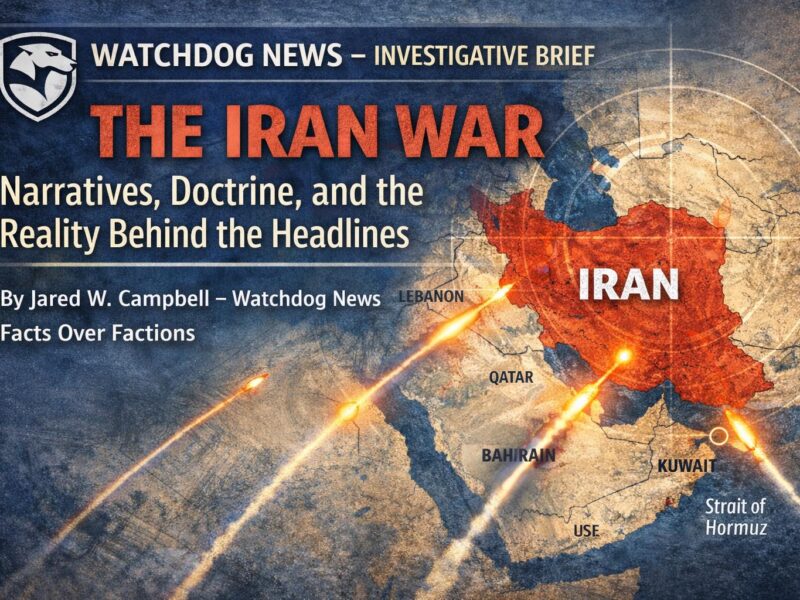
>Meanwhile, Iraq, often overlooked in the headlines, faced an escalating wave of proxy attacks, retaliatory strikes, and strategic maneuvers.
At first glance, each of these occurrences might seem isolated. However, together they signal a deeper crisis: a war drifting beyond its original intent, while its justification comes under fire.
While we’re not quite at the brink of collapse, we’ve certainly reached a pivotal moment where the integrity of the entire system begins to fray.
🧾 The Resignation — A Break from Within
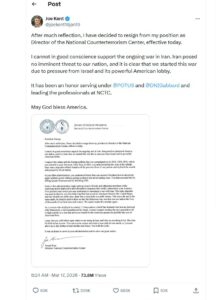
The resignation of Joe Kent, former Director of the National Counterterrorism Center, represents more than a personnel change. It is a structural break inside the national security framework.
Kent’s resignation letter did not rely on vague disagreement. It made specific claims:
-
That Iran did not pose an immediate or imminent threat to the United States
-
The decision to engage in war may have been influenced by external pressure and narrative shaping
-
That the current trajectory risks repeating historical mistakes tied to prolonged Middle East conflicts
These claims matter not because they are automatically true, but because of where they come from.
Kent is not an external critic or political opponent. He operated inside the intelligence and counterterrorism apparatus. His perspective reflects internal exposure to the processes by which threat assessments are formed, interpreted, and acted upon.
Public resignations during wartime are rare. Public resignations that challenge the foundation of the war itself are even rarer.
This is what elevates the event from political noise to strategic signal.
⚖️ The Intelligence Conflict — Two Narratives, One Decision
At the center of this situation is an unresolved contradiction.
On one side, the administration maintains that:
-
Iran posed a credible and imminent threat
-
Intelligence gathered from multiple sources justified preemptive military action
-
The decision to strike was necessary to prevent a larger conflict
On the other side, Kent’s position—and reportedly the view of some officials in private briefings—suggests:
-
The threat may not have been immediate
-
Intelligence may not have supported urgent military escalation
-
External or political factors may have influenced the interpretation of available information
This creates a fundamental problem:
Public policy has moved forward without publicly verifiable alignment on the intelligence that justified it.
The absence of transparency is not unusual in national security matters. However, when conflicting narratives emerge from within the same system, the lack of clarity becomes a liability.
Historically, this is the stage where:
-
Public trust begins to erode
-
Congressional pressure increases
-
Independent investigations become more likely
The key issue is not which narrative is correct.
The key issue is that the system is no longer presenting a unified assessment of reality.
🌍 The Expanding Battlefield — From Contained Conflict to Network War
Officially, the conflict is framed as a targeted military engagement involving Iran and coordinated actions with allied forces.
Operationally, that framing is becoming outdated.
Modern conflicts do not expand through formal declarations. They expand through interconnected pressure points, indirect engagements, and layered responses across multiple regions.
What is emerging is not a single-front war, but a networked conflict structure:
-
Direct military actions targeting Iranian assets and leadership
-
Retaliatory responses through proxy forces
-
Increased activity across adjacent regions with existing geopolitical tension
This type of conflict is more difficult to control because it lacks a clear boundary. Each action creates secondary and tertiary effects that extend beyond the original theater.
The most important of those secondary theaters is Iraq.
🧠 Iraq — The Structural Center of Escalation
Iraq’s role in this conflict is not incidental. It is structural.
The country sits at the intersection of multiple competing forces:
-
U.S. military presence, including bases, advisors, and intelligence infrastructure
-
Iran-backed militias operating with varying degrees of autonomy
-
A central government with limited ability to fully control armed factions within its borders
This combination creates an environment where escalation does not require formal authorization. It can occur organically through the actions of semi-independent actors.
Recent patterns indicate:
-
Increased drone and missile attacks targeting U.S. positions
-
Militia activity aligned with Iranian strategic interests
-
Retaliatory responses that risk drawing U.S. forces deeper into localized engagements
This is not a new dynamic. It is a continuation of a model that has defined regional conflict for over a decade.
⚔️ The Mechanics of Proxy Escalation
To understand why Iraq is becoming central to the conflict, it is necessary to understand how proxy warfare operates in practice.
The sequence is consistent:
-
A direct conflict emerges between state actors
-
One or both sides seek to avoid full-scale confrontation
-
Proxy groups are activated to apply pressure indirectly
-
Attacks occur in regions where deniability is possible
-
Retaliation follows, often within the same secondary theater
This creates a cycle where:
-
Escalation occurs without formal declarations
-
Responsibility is diffuse and difficult to assign definitively
-
The conflict expands geographically while remaining politically ambiguous
Iraq fits this model precisely.
It provides:
-
Access to U.S. targets
-
Operational space for militias
-
Political ambiguity that allows both sides to manage escalation thresholds
In this sense, Iraq is not simply involved in the conflict.
It is becoming the primary arena for indirect confrontation.
🔁 Historical Parallels — Patterns That Cannot Be Ignored
The current trajectory reflects patterns seen in previous conflicts.
During the Iraq War in 2003:
-
Intelligence assessments were later questioned
-
The scope of the conflict expanded beyond initial expectations
-
Insurgency and proxy dynamics prolonged engagement
During the broader War on Terror:
-
Direct military action transitioned into long-term regional instability
-
Iraq became a sustained operational environment for multiple actors
-
Clear objectives became increasingly difficult to define and maintain
“The present situation is not identical.
However, the structural similarities are difficult to ignore.”
When:
-
Intelligence is contested
-
Secondary theaters become active
-
Proxy dynamics take hold
“The risk is not immediate failure.
The risk is extended engagement without a clear strategic endpoint.”
⚠️ Strategic Outlook — What Comes Next
In the short term, the situation may involve the following:
• continued proxy attacks within Iraq
• ongoing direct and indirect exchanges between U.S., Israeli, and Iranian forces
• increased pressure on U.S. leadership to clarify objectives
Over the medium term, the outlook may include:
• greater U.S. involvement in Iraq-based engagements
• rising risk to personnel and infrastructure
• intensified domestic political debate over the war
Looking further ahead, long-term dynamics could involve:
• potential entrenchment of a multi-theater conflict
• economic and military strain
• strategic fatigue similar to previous prolonged engagements in the region
Importantly, none of these outcomes is guaranteed.
However, all are consistent with the current trajectory.
🧩 Reframing the Kent Resignation
When viewed in isolation, Kent’s resignation can be interpreted as a policy disagreement.
When viewed within the broader context of:
-
Expanding conflict dynamics
-
Proxy escalation in Iraq
-
Competing intelligence narratives
It takes on a different meaning.
It becomes an early signal that:
The internal understanding of the war may not align with its direction
This does not confirm wrongdoing.
But it does indicate that consensus has broken down at a critical moment.
👁 Watchdog Perspective — The Real Risk
The most significant risk isn’t solely that the war was initiated under pretenses. The real challenge lies in the contested justification, the expanding battlefield, and the unclear long-term objectives. This combination drives us toward reactive decisions instead of strategic ones. When that occurs, conflicts can outgrow their original purpose.
🔥 Final Assessment
This moment may not be a definitive turning point, but it represents a measurable shift. A senior official has bravely questioned the war’s foundation. Iraq is stepping into the spotlight as a key arena for transformation. The narrative supporting the conflict is evolving, no longer a unified front. These developments are interconnected, serving as powerful indicators of a system under pressure—and within that pressure lies the potential for change.