

Global markets are sending a clear signal.
Oil is rising.
Currencies are shifting.
Stocks are weakening.
The Iran conflict is now being priced as a prolonged geopolitical shock.
Global Markets Signal War Pressure as the Iran Conflict Enters a Dangerous Economic Phase
By Jared W. Campbell — Watchdog News
March 14, 2026
👁 Facts Over Factions

In the last 18 hours, global markets have begun to reveal a truth that many political leaders seem hesitant to acknowledge outright:
The conflict in Iran is now seen as a prolonged geopolitical shock—one that could have lasting implications.
Equities have stumbled across various regions, while commodities tied to war logistics have surged. Investors are gravitating towards safe-haven currencies, and energy prices are climbing yet again.
This isn’t just a knee-jerk reaction to the latest headlines. Markets are responding to the unsettling reality that the war could escalate or linger far longer than anyone initially anticipated. The air is charged with uncertainty, and it’s clear that traders are bracing for the storm ahead.
Oil, Energy, and the Strait of Hormuz
Energy markets remain the clearest indicator of geopolitical tension.
Over the last trading window:
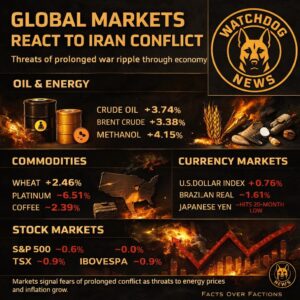
- WTI crude rose 3.74%
- Brent crude climbed 3.38%
- Gasoline prices rose 3.40%
- Methanol surged 4.15%
These gains come as tensions in the Strait of Hormuz continue to undermine confidence in global shipping.
Roughly 20% of the world’s traded oil passes through the narrow waterway.
Even partial disruptions—insurance spikes, tanker rerouting, naval patrols, or missile threats—can send energy markets sharply higher.
Higher energy prices ripple across the global economy through:
- transportation costs
- manufacturing input prices
- agricultural logistics
- consumer inflation
This is one reason economists fear the conflict could push the global economy toward stagflation, where inflation rises while growth slows.
Commodity Markets: War Logistics and Food Signals
Commodity trading also reflected war-related stress.
Agricultural commodities
- Wheat +2.46%
- Cotton +1.01%
- Coffee –2.39%
https://tradingeconomics.com/commodities
Rising wheat prices often occur when markets anticipate:
- shipping disruptions
- fertilizer supply concerns
- geopolitical instability affecting crop regions
Meanwhile, metals showed mixed signals.
Metals markets
- Platinum –6.51%
- Silver –3.92%
- Copper –3.36%
- Gold –1.12%
One key factor here is the strengthening U.S. dollar, which tends to put downward pressure on metal prices globally.
However, iron ore and lithium both rose, reflecting continued demand tied to industrial supply chains.
https://tradingeconomics.com/stream
Currency Markets: Flight Toward the Dollar
Currency markets show classic risk-off behavior.
The U.S. Dollar Index rose 0.76%, while several global currencies weakened:
- Brazilian Real –1.61%
- New Zealand Dollar –1.39%
- Australian Dollar –1.36%
- Euro –0.83%
- British Pound –0.82%
Even the Japanese yen, traditionally considered a safe-haven currency, slid to a 20-month low near 159.69 per Dollar.
https://tradingeconomics.com/stream
Currency traders appear to be positioning for:
- prolonged geopolitical instability
- tighter monetary policy
- rising energy costs
Global Stock Markets Reflect Growing Uncertainty
Equity markets across multiple continents closed the week lower.
United States
- S&P 500 –0.6%
- Dow –0.3%
- Nasdaq –0.7%
Technology and software firms led declines.
Companies such as Adobe plunged more than 7%, while other major tech firms, including Meta Platforms and Oracle, also dropped.
Markets also reacted to comments from U.S. Defense Secretary Pete Hegseth, who confirmed the largest wave of strikes yet against Iranian targets.
Canada
The S&P/TSX Composite Index fell 0.9%.
Canada faced additional pressure from domestic economic data showing:
- 83,900 job losses
- Unemployment rising to 6.7%
Mining companies, including Barrick Gold and Agnico Eagle Mines, dropped between 3% and 4%.
Brazil
Brazil’s Ibovespa index fell 0.9%, reversing earlier gains.
The decline came despite positive domestic data showing 0.3% growth in services.
Markets instead focused on the global situation:
- oil approaching $100 per barrel
- rising container shipping costs
- Inflation risks tied to energy markets
The Military Picture Behind the Markets
The economic movements coincide with continued military escalation.
U.S. officials say more than 15,000 targets have been struck in Iran since the war began.
At the same time:
- Iranian missiles and drones continue to target Israel and regional infrastructure
- Hezbollah attacks have expanded in Lebanon
- Shipping disruptions in the Persian Gulf remain ongoing
The United States has also redeployed 2,500 Marines and an amphibious assault ship to the Middle East, reinforcing the possibility that the conflict could expand or persist.
Competing Strategic Narratives
Different governments and analysts see the conflict very differently.
Western perspective
Western officials argue that sustained airstrikes will weaken Iran’s military infrastructure and force negotiations.
Iranian perspective
Iranian leadership frames the conflict as resistance against foreign intervention and appears focused on:
- missile deterrence
- maritime pressure
- proxy warfare
Independent analysts
Some geopolitical analysts believe the war could evolve into a war of attrition, where the key question becomes endurance rather than battlefield breakthroughs.
The Russia and China Question
Another issue increasingly debated among analysts is whether Iran may receive indirect assistance from major powers such as Russia and China.
At present, there is no confirmed evidence of direct military involvement, but both countries have strong strategic interests in the region.
Analytical Note: As of March 2026, intelligence reports suggest that Russia and China are providing indirect assistance to Iran, primarily in the form of intelligence, surveillance, and technological components, rather than direct military involvement in the ongoing Iran-Israel/US conflict. While China has maintained a more cautious approach focused on diplomatic mediation and energy security, Russia has intensified its support by providing information on US military positions.
Possible forms of support analysts often discuss include:
- intelligence sharing
- diplomatic backing
- energy trade arrangements
- economic coordination to bypass sanctions
These possibilities remain speculative but are closely monitored by intelligence agencies and financial markets.
The Watchdog Perspective
During times of war, it’s easy to slip into the trap of oversimplifying events into straightforward tales of triumph or failure. However, the economic data that has surfaced over the past 18 hours reveals a far more intricate story.
The markets are behaving as though they anticipate a prolonged struggle rather than a swift resolution to the conflict. Instead of an immediate end, we’re looking at potential fallout that could include:
– Still Ongoing energy disruptions happening.
– There has been a huge spike in global inflation
– We see Stricter financial conditions
– The world has extended geopolitical unrest
Whether these scenarios will manifest remains unclear, but one thing is clear: the signals from markets, military movements, and diplomatic communications are converging toward a similar conclusion.
We may be entering a longer, more unpredictable chapter in this conflict.
Jared W. Campbell
👁 Facts Over Factions