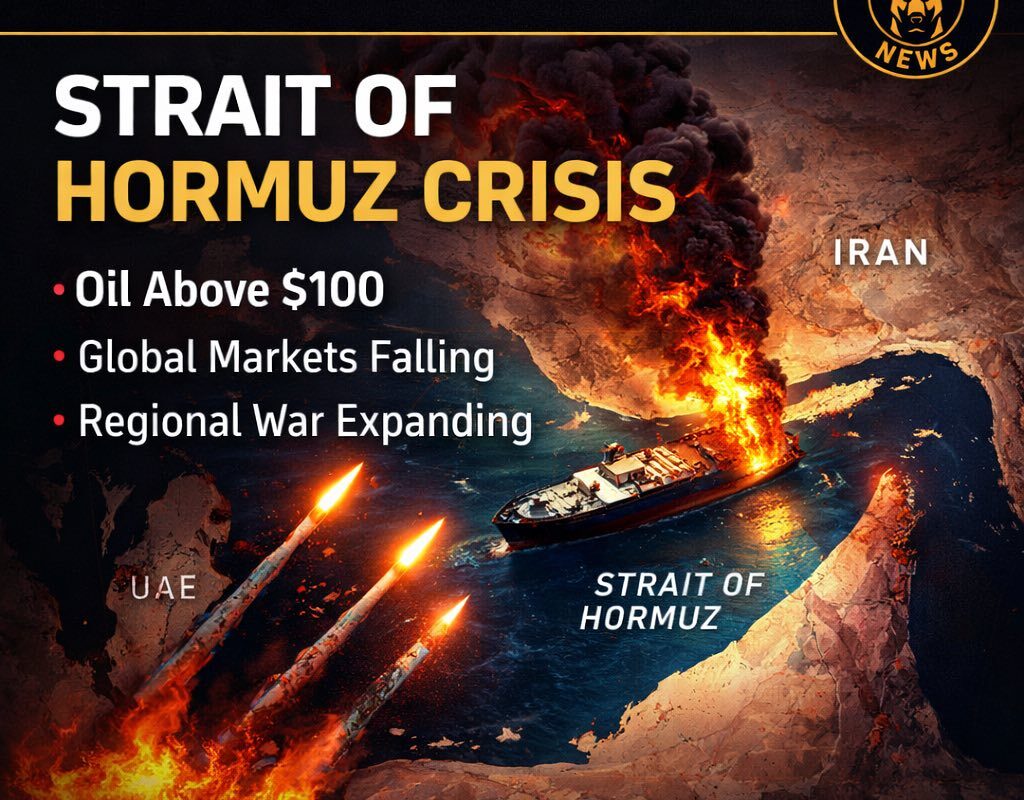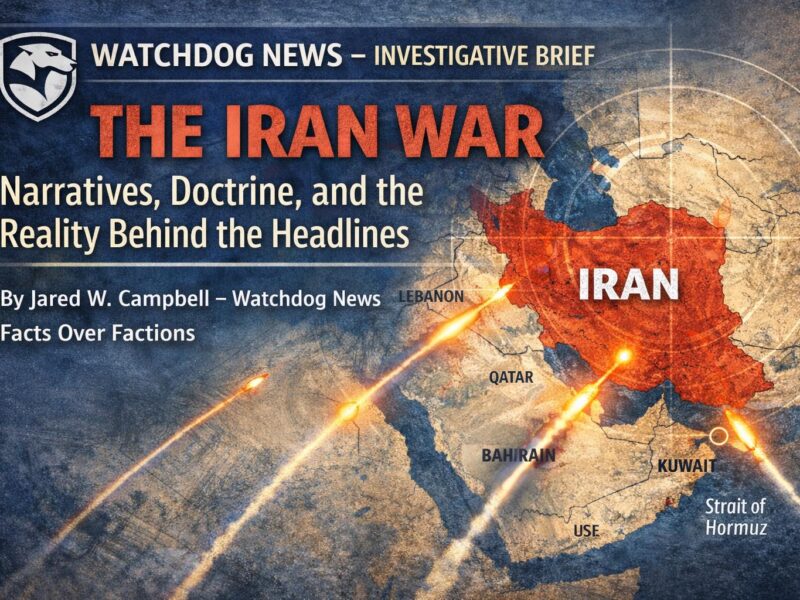


On March 8, 2026, oil prices surged above $100 per barrel as energy markets reacted to disruptions near the Strait of Hormuz.
Global Energy Shock Sends Ripples Through Financial Markets
Oil Surge Pressures Bonds, Currencies, and Equities Worldwide

By Jared W. Campbell — Watchdog News
Facts Over Factions
March 8, 2026
Introduction
A sudden surge in oil prices is sending shockwaves through global financial markets.
Data across multiple regions shows a consistent pattern: escalating conflict in the Middle East, disruptions around the Strait of Hormuz, and fears of prolonged energy supply constraints are now feeding directly into bond markets, currencies, stock indexes, and inflation expectations.
Oil has surged above $100 per barrel. Government bond yields are rising in major economies, including the United States, Japan, South Korea, and Australia. Meanwhile, several currencies have weakened against the U.S. dollar, and equity markets across Asia have declined sharply.
Taking it together, the developments suggest the world economy is entering a new phase of uncertainty driven primarily by energy supply risks.
Main Analysis
Energy Markets Are Driving the Global Reaction
Energy markets are at the center of the current turbulence.
Crude prices have surged above $100 per barrel, with some market updates indicating prices briefly reached $110. Brent crude rose more than 15%, while gasoline, heating oil, and natural gas prices also moved sharply higher.
The Strait of Hormuz plays a critical role in this development. According to the attached material, shipments through the route have been halted or significantly disrupted while several Middle Eastern producers have reduced output.
The Strait of Hormuz normally carries roughly one-fifth of global oil and gas shipments.
When supply risks emerge at that scale, the consequences ripple across the global economy. Higher energy costs quickly feed into transportation, manufacturing, agriculture, and household expenses. In turn, those pressures begin influencing financial markets, inflation expectations, and central bank policy outlooks.
Watchdog Verdict- Regarding the YouTube Video
| Category | Verdict |
|---|---|
| Energy shock explanation | Accurate |
| Strait of HorHormuz’sportance | Accurate |
| Market reaction description | Accurate |
| Oil price figures | Needs confirmation |
| Tanker disruption claim | Ambiguous |
| Trading promotion | Advertisement |
Final Score:
7.5 / 10 — Mostly accurate but slightly sensationalized.
Bond Markets Signal Rising Inflation Concerns
Government bond yields have climbed across several major economies.
Key movements include:
- South Korea’ s-year yield is rising to 3.77%, its highest level since April 2024
- Japan’ s-year yield is increasing to 2.22%, a three-week high
- AusAustralia’s-year yield is reaching 5.00%, the highest level since July 2011
- The U.S. 10-year Treasury yield is climbing to approximately 4.2%, near a one-month high
Bond markets often react quickly to changes in inflation expectations. The recent moves suggest investors are reassessing the outlook for monetary policy.
Earlier expectations that central banks might begin lowering interest rates are now facing renewed uncertainty as rising energy prices threaten to push inflation higher again.
In the United States, market participants are increasingly considering the possibility that the Federal Reserve could delay rate cuts if inflation pressures intensify.
Currency Markets Reflect a Flight Toward the Dollar
Foreign exchange markets are showing a broad shift toward the U.S. dollar.
The Dollar Index rose to 99.68, its highest level since November 2025.
At the same time, several currencies weakened:
- South Korean won fell below 1,500 per dollar, its weakest level since 2009
- Japanese yen declined past 158.5 per dollar, a six-week low
- Australian dollar continued to depreciate
- New Zealand dollar dropped to approximately $0.585
- The euro fell to around $1.152, its lowest level in more than three months
This pattern reflects a common market response during periods of geopolitical uncertainty: investors move toward perceived safe-haven assets.
For energy-importing economies, however, weaker currencies add another layer of risk because imported oil becomes more expensive in local terms. That dynamic can intensify inflation pressures and widen trade deficits.
Japan and South Korea appear particularly exposed due to their heavy reliance on imported energy from the Middle East.
Equity Markets React to Slower Growth Risks
Stock markets across Asia and U.S. futures markets have also declined.
Recent movements include:
- South Korea’s SPI is falling nearly 7%
- Japan’s Nikkei 225 is dropping roughly 6%
- China’s Shanghai Composite fell to a four-week low
- AusAustralia’sP/ASX 200 is declining 3.3%
- U.S. stock futures for the Dow, S&P 500, and Nasdaq are also moving lower
Technology, semiconductor, mining, and financial stocks were among the sectors most affected.
Such market reactions often occur when investors begin pricing in the possibility that higher energy costs could weaken economic growth while inflation pressures remain elevated.
This environment can complicate the outlook for both businesses and policymakers.
Perspectives
Economist Perspective
From an economic standpoint, the data suggest the return of a familiar risk: an energy-driven inflation shock.
The combination of rising oil prices, increasing bond yields, falling equity markets, and a stronger U.S. dollar can signal growing concern about a potential stagflation scenario—where inflation remains elevated while economic growth slows.
Recent data from China adds complexity to the global picture. ChiChina’sflation rose to 1.3% in February 2026, the highest level since January 2023, while producer prices declined 0.9% year-over-year, the smallest drop since mid-2024.
This suggests the global inflation environment remains uneven, making it more sensitive to external shocks such as energy disruptions.
Former British diplomat Alastair Crooke argued in a March 2 interview with Glenn Diesen that Iran’s broader strategy is not simply retaliation, but to raise the military and economic cost of continued U.S. presence in the region. Some of Crooke’s battlefield claims remain difficult to verify independently. Still, his comments reflect a school of analysis that views the conflict as part of a broader contest over U.S. military presence, Gulf security architecture, and regional energy corridors.
“Iran spent years fostering proxies in Iraq. Now, many aren’t eager to join the war.” This directly helps us test Crooke’s core thesis that Iran’s strategy is to push the U.S. out of the region by applying pressure on American bases and regional networks. Reuters reports that many Iraq-based Shi’ite militias have so far launched few attacks and are muted or divided, which gives the Watchdog a grounded counterweight to Crooke’s stronger claims. https://www.reuters.com/world/middle-east/iran-spent-years-fostering-proxies-iraq-now-many-arent-eager-join-war-2026-03-06/
“Israel pounds Iran and Lebanon; Trump weighs military …” — this is the stronger broad news framing piece. Reuters reports that Israeli and U.S. leaders hoped the attack might trigger an uprising, but Reuters found no evidence that one was imminent. That is useful because Crooke also discusses regime-change assumptions, and Reuters provides a more cautious baseline. https://www.reuters.com/world/iran-live-israel-strikes-hezbollah-uk-base-hit-cyprus-conflict-widens-2026-03-02/
“US not veering into a new, endless war, Pentagon says” — this gives us the official U.S. frame, including that officials expected more casualties and were trying to manage fears of an open-ended conflict. It is useful for the Watchdog in discussing whether Washington is confident or under pressure. https://www.reuters.com/world/middle-east/top-us-general-will-take-time-achieve-objectives-iran-2026-03-02/
Policymaker Perspective
Central banks are now facing a difficult balancing act.
If higher oil prices persist, policymakers may need to consider whether inflation pressures are temporary or likely to spread more broadly through the economy.
Recent commentary referenced in the source material highlights these concerns:
- The Federal Reserve may delay rate cuts if inflation expectations rise
- The Reserve Bank of Australia has indicated it is closely monitoring inflation risks tied to energy markets
- The Bank of Japan faces added uncertainty as higher oil prices complicate its economic outlook
- European Central Bank officials have warned that they “cannot be complacent” about energy-driven inflation pressures
Governments may also consider strategic responses, including the potential release of national oil reserves in some countries.
Industry Perspective
Businesses are already beginning to feel the effects of rising energy costs.
Industries with heavy fuel consumption—including transportation, logistics, manufacturing, and agriculture—are particularly exposed to sustained increases in oil prices.
Agricultural markets may also face pressure. Wheat prices have recently risen amid concerns about higher fertilizer costs, shipping risks, and global supply uncertainties.
Technology and export-driven industries have also been affected in equity markets. Major semiconductor and electronics firms in Japan and South Korea saw steep declines as investors reassessed prospects for global demand.
Household Perspective
For households, the most immediate concern is the cost of living.
Higher oil prices often translate into higher fuel, transportation, and food costs. Over time, these increases can reduce purchasing power and place pressure on household budgets.
Recent inflation data from Bangladesh illustrates this impact. Consumer prices rose 9.13% year over year, driven largely by increases in food and household goods.
In China, food prices also increased 1.7%, reflecting stronger demand during the Lunar New Year period and rising costs for vegetables and fruit.
Even modest increases in the prices of essential goods can significantly affect household spending patterns.
Key Outcomes and Implications
Several major developments emerge from the data.
First, energy supply disruption has become the central economic risk affecting global markets.
Second, financial markets are reassessing expectations for interest rate cuts amid higher energy prices, which threaten to push inflation higher again.
Third, energy-importing economies, particularly in Asia, appear especially vulnerable due to their reliance on imported fuel.
Fourth, global risk sentiment has weakened, reflected in falling equity markets and a stronger U.S. dollar.
Finally, the global inflation outlook remains uncertain, with price pressures emerging unevenly across different regions.
Conclusion
The available data points to a global economy facing renewed pressure from energy markets.
Oil prices above $100 per barrel, rising government bond yields, a strengthening U.S. dollar, weaker regional currencies, and declining equity markets all suggest investors are reassessing the economic outlook.
For economists, the concern centers on the potential return of energy-driven inflation.
-For policymakers, the challenge lies in responding to supply-driven price pressures without weakening economic growth.
-For businesses and households, the immediate impact is higher costs and increased uncertainty.
The broader takeaway is clear: disruptions in global energy supply are no longer just a regional issue. They are increasingly shaping the trajectory of the global economy.
Jared W. Campbell- Watchdog News
Facts over Factions
Links- https://tradingeconomics.com/stream