

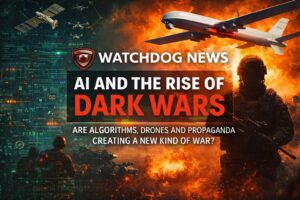
Wars are changing.
Artificial intelligence, drones, cyber attacks, and algorithm-driven propaganda are quietly reshaping modern conflict.
Some analysts now call this new environment “dark wars” — conflicts fought with technology, data, and information rather than massive troop deployments.
Facts Over Factions.
AI, Modern Warfare, and the Rise of “Dark Wars”

By Jared W. Campbell — Watchdog News
Facts Over Factions
The Theory
A growing number of analysts are raising alarms about a new era of warfare—one increasingly shrouded in secrecy and driven by artificial intelligence.
They argue that AI is rapidly becoming a vital instrument for governments seeking to pursue conflicts with minimal public scrutiny and reduced political fallout.
As a result, this shift suggests a future in which wars are fought in the shadows rather than through large conventional deployments.
Instead, we may see what some analysts describe as “dark wars”—covert confrontations carried out through advanced technology and strategic algorithms.
In other words, warfare may increasingly move away from visible troop deployments and toward technologically driven operations.
For example, key elements of these “dark wars” include the following:
• drones
• cyber attacks
• autonomous systems
• intelligence algorithms
• proxy forces
Together, these tools could reduce the need for massive conventional invasions.
Ukraine: The First AI-Integrated Battlefield
The war in Ukraine has become the clearest modern example of this shift.
For example, both Ukraine and Russia have already used AI-assisted systems for the following tasks:
• drone targeting
• satellite analysis
• battlefield mapping
• artillery fire correction
• surveillance pattern recognition
In addition, commercial satellite imagery combined with AI has allowed near-real-time tracking of troop movements.
In some cases, algorithms analyze thousands of images to identify potential military targets faster than human analysts could.
Why Governments Might Prefer This Model
From a political standpoint, AI-driven warfare offers several advantages.
Lower Visible Casualties
Historically, large troop losses have sparked domestic political backlash.
However, remote systems—such as drones, cyber operations, and autonomous weapons—reduce the need for direct troop deployments.
Plausible Deniability
Cyber attacks or proxy operations can be difficult to attribute definitively.
As a result, governments can operate in gray areas without triggering formal declarations of war.
Faster Decision Cycles
AI systems can process battlefield data far faster than traditional command structures.
Consequently, that speed advantage can shape battlefield outcomes.
The Strategic Logic
Military planners often describe this transition as a shift from industrial warfare to algorithmic warfare.
Traditionally, warfare relied on several key factors, including the following:
• workforce
• industrial production
• territorial control
In contrast, AI-driven warfare relies more heavily on several key elements, including the following:
• data
• algorithms
• sensors
• networked systems
Ultimately, the side that processes information fastest often gains the advantage.
The Hidden Battlefield: Information and Algorithmic Propaganda
One of the most overlooked aspects of modern conflict is the information battlefield.
Today, propaganda does not spread only through television or newspapers.
Instead, it spreads through algorithms.
Artificial intelligence systems now power the content recommendation engines used by major social media platforms.
These algorithms determine what billions of people see every day.
During wartime, this creates a powerful environment for information manipulation.
False or misleading battlefield claims can spread rapidly when amplified by algorithms designed to prioritize the following:
• engagement
• emotional reactions
• viral content
Consequently, images, videos, and dramatic claims—whether accurate or not—can reach millions of people within hours.
In many cases, these stories circulate far faster than verified reporting.
The TikTok video raises questions about the truth. Both sides say two different things; the picture of the soldiers doesn’t appear to be AI. Once again, for transparency, the Watchdog will be fair.
Al Jazeera reported- Showing examples of possible information warfare.
Trump administration denies reports that Iran captured US soldiers
The head of Iran’s National Security Council had claimed the US was misrepresenting the captures as combat deaths.
@zoeyshop_
The result is a modern propaganda environment where:
As a result, a modern propaganda environment emerges where the following patterns appear:
• misinformation spreads quickly
• battlefield rumors gain credibility through repetition
• public perception becomes part of the battlefield itself
Artificial intelligence does not create propaganda on its own.
However, it accelerates and amplifies it through algorithmic distribution.
This dynamic has become increasingly visible during recent conflicts, where viral posts, recycled images, and exaggerated casualty claims often circulate widely before facts can be confirmed.
The Link to Fifth-Generation Warfare
Many military theorists describe this environment as part of Fifth Generation Warfare (5GW).
Unlike traditional wars fought primarily with weapons and armies, fifth-generation warfare emphasizes information and perception.
Key characteristics of Fifth Generation Warfare include the following:
• information warfare
• psychological operations
• cyber attacks
• economic pressure
• narrative control
Within this framework, shaping public perception can become as important as winning battles.
If populations can be confused, divided, or manipulated through information campaigns, strategic objectives may sometimes be achieved without traditional military victory.
In addition, AI-powered information ecosystems make this form of warfare significantly more powerful.
As a result, algorithms can unintentionally amplify propaganda from multiple sides simultaneously, creating an environment where truth becomes harder for the public to identify.
But AI Was Not Created Only for War
While AI is now heavily used by militaries, it was not originally designed solely for warfare.
Instead, AI research developed primarily from several fields, including the following:
• computer science
• data analysis
• automation technologies
• commercial applications
Today, AI is used across many civilian fields, including the following:
• medicine
• logistics
• transportation
• manufacturing
• climate modeling
However, history shows that once powerful technologies emerge, military adoption almost always follows.
Historical Parallels
Many major technologies were originally civilian inventions that later became central to warfare.
Examples include:
Radio → battlefield communications
Jet engines → military aircraft
GPS → missile guidance
The internet → cyber warfare
AI may be the next technology in that historical cycle.
The Watchdog Perspective
Artificial intelligence is not necessarily the cause of modern conflicts.
However, it is clearly changing how wars are fought.
Rather than massive battles between armies, conflicts may increasingly involve the following forms of activity:
• intelligence operations
• economic pressure
• cyber warfare
• drones and autonomous systems
• information warfare
Importantly, these forms of conflict often occur below the threshold of traditional war, making them far less visible to the public.
At the same time, algorithm-driven information ecosystems may expose the public to waves of propaganda and misinformation amplified by automated systems.
As a result, this creates a paradox.
Wars may become less visible on the battlefield, yet far more chaotic in the information space.
That raises an important question for democratic societies:
If wars become less visible—and if the information environment itself becomes contested—how can citizens maintain oversight of the decisions being made in their name?
The Bottom Line
Artificial intelligence was not originally designed to wage wars.
However, like many transformative technologies before it, AI is now being woven into the fabric of military strategy.
The profound change lies not in AI creating a new type of conflict, but in its ability to facilitate wars that are fought more quietly, more indirectly, and with far less public awareness than ever before.
At the same time, AI-powered information systems are reshaping how propaganda spreads, turning social media algorithms into an increasingly important part of the modern battlefield.
Ultimately, this convergence of technology, warfare, and information control represents one of the defining security challenges of the 21st century.
And it is precisely why vigilance from a Watchdog is essential. 👁️
Jared W. Campbell
Watchdog News
Facts Over Factions

— Watchdog News
👁️ Facts Over Factions