

Iran War Ripples Reach the Eastern Mediterranean

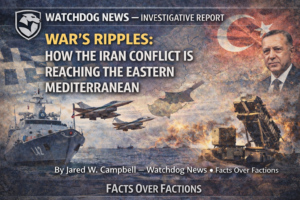
War’s Ripples: How the Iran Conflict Is Reaching the Eastern Mediterranean
Greece, Turkey, and the Return of Old Fault Lines
By Jared W. Campbell — Watchdog News
Facts Over Factions
Introduction — A Veteran Watches the Map
War rarely keeps to its own borders.
As a man of faith, a veteran of the Iraq War, and a student of history, I’ve come to understand that conflict flows like water, seeping into every fissure in the geopolitical landscape. Sometimes, those fissures are found thousands of miles away from their source.
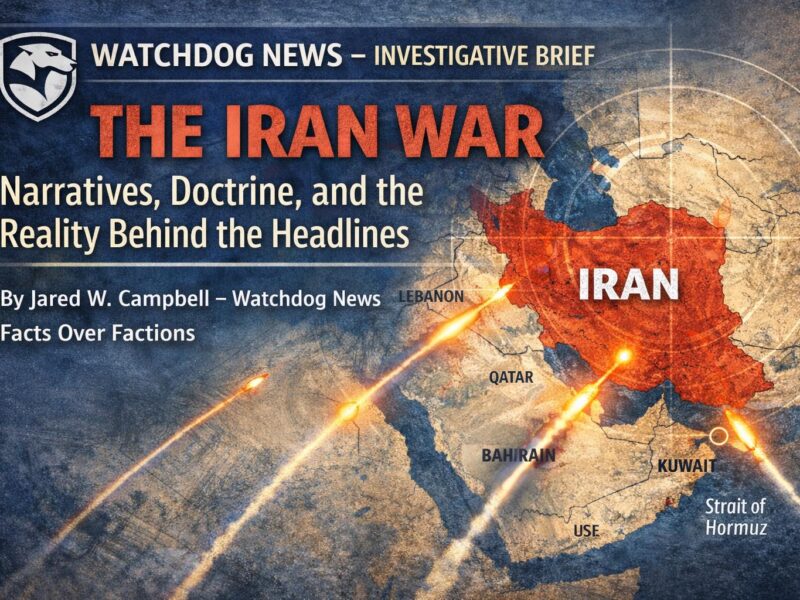
Right now, the war involving Iran is not just reshaping the Middle East; it is sending ripples across the Eastern Mediterranean, a region steeped in its own unresolved tensions, delicate alliances, and memories of past battles.
And now, those age-old fault lines are shifting once more.
In recent days, Greece has dispatched naval and air assets to Cyprus, while Turkey has issued stern warnings regarding security and treaty obligations. At first glance, this may seem unrelated to the conflict in Iran.
But history often reveals a crucial lesson: regional wars rarely remain confined to their starting points.
The Military Movements: Greece Moves Toward Cyprus
Two Greek frigates — “Psara” and “Kimon” — recently entered Cypriot waters amid rising tensions tied to developments in the wider Middle East conflict.
According to reporting from Greek outlet NEWS 24/7, the frigates departed from the Salamis Naval Base and arrived in Cypriot waters early in the morning before docking near Limassol and Akrotiri.
Source: https://www.news247.gr
At roughly the same time:
- Greek F-16 fighter jets deployed to Cyprus
- The Cypriot Flight Information Region (FIR) was temporarily closed
- Authorities responded to a suspicious airborne object, raising fears of drone activity linked to regional conflict dynamics.
Greek Defense Minister Nikos Dendias confirmed the deployments as part of defensive coordination with Cyprus.
He stated:
“Greece will provide whatever assistance it can to Cyprus, based on its capabilities.”
Source: https://www.news247.gr
The move included not only frigates and aircraft but also advanced systems such as the Centauros defense system, reinforcing Cyprus amid what Greek officials described as “threats and illegal actions” in the region.
The Turkey Reaction: Old Tensions Re-Emerge
The deployment immediately triggered a reaction from Ankara.
Turkish Foreign Ministry spokesman Öncü Keçeli criticized the Greek moves, warning that they risk destabilizing the balance established by international treaties.
Turkey pointed to the Lausanne Treaty (1923) and the Paris Treaty (1947) — agreements that placed certain Aegean islands under demilitarized status.
Keçeli stated:
“Any step taken by these circles… in violation of international law is null and void.”
Source: https://www.news247.gr
Turkey also emphasized that Turkish Cypriots and Northern Cyprus are capable of ensuring their own security with Ankara’s support.
The message was clear:
Turkey views the Greek deployments not simply as defensive measures but as potential geopolitical positioning.
The Strategic Context: Why the Iran War Matters Here
At first glance, the Eastern Mediterranean dispute between Greece and Turkey may appear separate from the Iran war.
But analysts say the two developments are connected.
The Iran conflict has increased uncertainty across the entire region, pushing NATO members to reposition forces and secure potential flashpoints.
The Greek government has argued that the deployments are purely defensive and part of broader regional stability efforts.
However, Turkish officials fear that Greece may use the situation to strengthen its strategic position in the region.
According to political analysis cited by Greek outlet NEWS 24/7, some officials in Athens believe the Iran war could reduce Turkey’s influence in Western strategic planning.
Source: https://www.news247.gr
One scenario discussed in Western policy circles suggests that if Iran were weakened or politically transformed, it could become a major strategic partner for the United States — potentially altering the regional balance of power that currently includes Turkey.
The Wall Street Journal has discussed similar strategic debates over Turkey’s reliability as an ally in the Middle East.
Source: https://www.wsj.com
ErdErdoğan’slancing Act
Turkey now faces a complex geopolitical challenge.
President Recep Tayyip ErdErdoğans historically pursued a dual-track foreign policy:
- maintaining NATO ties with the West
- positioning himself as a leader within the Muslim world
The Iran war complicates that balance.
Turkey has condemned Israeli strikes on Iran in general terms but has avoided escalating rhetoric.
At the same time, NATO missile defenses operating in the region reportedly intercepted a ballistic missile passing through airspace near Turkey after traveling through Syria and Iraq.
Source: https://www.news247.gr
Iranian officials denied launching that missile.
Such incidents highlight how quickly regional conflicts can expand into wider theaters.
The Cyprus Factor: A Long Shadow
Cyprus has been one of the most persistent geopolitical flashpoints in the Mediterranean since Turkey’s military intervention on the island in 1974.
The island remains divided between:
- The Republic of Cyprus (internationally recognized)
- The Turkish Republic of Northern Cyprus (recognized only by Turkey)
Because Greece is the Republic of Cyprus’s principal security partner, any escalation involving Cyprus carries direct implications for Greek-Turkish relations.
Now, with war spreading uncertainty across the region, even routine military deployments take on heightened meaning.
The Strategic Fear: Escalation Through Alliances
The deeper concern is not an immediate conflict between Greece and Turkey.
It is something more subtle.
Regional wars tend to pull neighboring states into defensive postures.
Defensive postures can trigger reactions.
And reactions can create chains of escalation.
Some analysts fear that if the Iran conflict expands — particularly if naval operations or energy disruptions reach the Mediterranean — NATO members could find themselves navigating overlapping crises.
One involving Iran.
Another involves long-standing disputes among alliance members.
The Watchdog Perspective
As someone who has worn the uniform, I understand how quickly military positioning can shift from precaution to confrontation.
But as someone who believes in truth and faith, I also understand that fear and speculation often distort reality during wartime.
Right now, the verified facts remain straightforward:
- Greece deployed naval and air assets to Cyprus amid regional instability.
- Turkey criticized the move and invoked historical treaties.
- Both countries remain NATO allies, navigating the shadow of a wider war.
What happens next will depend not only on the Iran conflict but on how regional powers interpret each other’s intentions.
History shows that misunderstandings during war can be just as dangerous as missiles.
Watchdog Closing Statement
The Iran war is not only being fought with missiles and drones.
It is also reshaping alliances, testing old rivalries, and exposing how fragile regional balances truly are.
The Eastern Mediterranean has been a crossroads of empires for thousands of years.
Today, it is once again feeling the tremors of a distant conflict.
The Watchdog’s job is not to amplify fear or pick political sides.
The Watchdog’s job is to follow the evidence, examine the connections, and remind readers that wars rarely stay confined to the places where they begin.
Because when the map starts moving, wise nations — and wise citizens — pay attention.
👁 Jared W. Campbell
Watchdog News
Facts Over Factions