

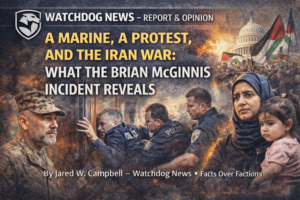
A Marine veteran interrupts a Senate hearing on the Iran war.
He is arrested.
His arm is broken during the struggle.
Now the country is debating war, free speech, and the role of veterans in political protest.
Facts Over Factions.
A Marine, A Protest, and the Iran War: What the Brian McGinnis Incident Reveals
By Jared W. Campbell — Watchdog News
Facts Over Factions
Introduction — When a Veteran Speaks
Both my wife and I are veterans. When a story involves a Marine, a protest, and a war debate inside the halls of Congress, it naturally draws our attention.
Not because we agree with everything that was said.
But because we understand what it means when someone who has worn the uniform decides to speak out about war.
After researching the Brian McGinnis incident across multiple sources, one thing becomes clear: this story is not as simple as many headlines suggest. As in most conflicts and political debates, multiple perspectives compete for attention.
From a Watchdog and veteran’s perspective, I agree with Brian McGinnis on one point: no American should die in a war for another nation’s interests.
At the same time, I disagree with him politically in many areas.
But disagreement does not erase respect.
Brian McGinnis is a Marine veteran of the Iraq War, and that alone earns a level of respect that political arguments cannot erase.
The purpose of this report is not to defend him or condemn him.
It is to lay out the facts and understand what this moment actually reveals.
The Brian McGinnis Incident: What Happened
Who Brian McGinnis Is
Brian C. McGinnis is not a random protester.
He is:
– A U.S. Marine Corps veteran
– A former Iraq War serviceman
– A Green Party candidate for U.S. Senate in North Carolina
– Described in some reports as a firefighter and political activist
This background matters.
When a veteran interrupts a Senate hearing about war, the symbolism is powerful, whether one agrees with the message or not.
The Capitol Incident
Date: March 4–5, 2026
Location: U.S. Capitol — Senate Armed Services Subcommittee hearing on the Iran War.
During the hearing, McGinnis stood up and interrupted proceedings while criticizing U.S. policy toward Iran and Israel.
The phrase that quickly circulated across media and social platforms was:
“No one wants to fight for Israel.”
Capitol Police quickly moved to remove him from the hearing room.
During the removal, several things occurred:
– McGinnis grabbed onto the doorframe while officers attempted to escort him out.
– Senator Tim Sheehy (R-Montana) left his seat and physically assisted police in removing him.
– During the struggle, McGinnis’ arm or hand became caught in the door and was broken.
He was transported to George Washington University Hospital for treatment.
Criminal Charges
Following the incident, Capitol Police arrested McGinnis and filed several charges, including:
– Three counts of assault on a police officer
– Three counts of resisting arrest
– Unlawful demonstration/obstruction inside Congress
Police claim McGinnis violently resisted removal.
This is the official law enforcement narrative.
Competing Narratives
This is where a Watchdog approach becomes necessary.
The Law Enforcement Position
Authorities say:
– McGinnis resisted removal
– Officers were assaulted during the struggle
– The force used was necessary to restore order inside a congressional hearing
Senator Tim Sheehy later said the protester “came looking for a confrontation.”
Supporters’ Position
Supporters of McGinnis claim something different.
They argue:
– Excessive force was used
– The physical struggle with officers and the senator may have caused his injury
– The incident reflects suppression of anti-war speech
What the Video Evidence Shows
Available video confirms several basic facts:
– McGinnis interrupted the hearing
– Capitol Police attempted to remove him
– Senator Sheehy assisted in the removal
– McGinnis’ arm was injured during the confrontation
The footage does not definitively show who is directly responsible for the injury.
That remains disputed.
Why This Incident Matters
This moment touches several deeper fault lines inside the United States.
1. The Iran War Debate
The protest occurred during a hearing about the U.S. strategy toward Iran.
That alone makes it politically explosive.
America is once again debating the possibility of another Middle East conflict.
Veterans know what those debates can lead to.
2. Veterans and War
A Marine veteran interrupting Congress to protest the war carries weight.
Veterans historically have played a role in anti-war movements.
Vietnam veterans did it.
Iraq veterans did it.
Now it is happening again.
3. Political Polarization
The phrase “No one wants to fight for Israel” triggered immediate reactions online.
Supporters of Israel saw it as offensive.
Others interpreted it as a criticism of American foreign policy.
Regardless of interpretation, it shows how sensitive Middle East policy has become in American politics.
” Even I was first set off by what I saw; this is a good example of how information warfare is used successfully.”
– Jared W Campbell- Watchdog News
4. Free Speech vs Order in Congress
Demonstrations inside congressional hearings are illegal.
But critics argue the aggressive removal of protesters raises questions about how dissent is handled.
That debate is not new.
It has been happening in Congress for decades.
The Personal Context Behind McGinnis
Another part of the story involves McGinnis’ family background.
Brian McGinnis is married to a Palestinian woman named Hamadee.
The couple lives in Wendell, North Carolina, with their four children.
According to reporting and statements from family members:
– McGinnis often speaks about his wife’s Palestinian relatives
– The situation in Gaza and the West Bank influenced his views on Middle East policy
His mother reportedly said:
“He talks a lot about her family and Israel.”
McGinnis has also participated in activism related to Gaza, including involvement with the Freedom Flotilla Coalition, a group that seeks to deliver humanitarian aid to the region.
Some reports say he has claimed that his wife owns a home in the West Bank.
However, his wife herself is not a public political figure.
Most references to her appear only as context explaining McGinnis’ political motivations.
A Veteran’s Perspective
As someone who served during the Iraq War era, I understand how complicated these conversations become.
War is never just a strategy.
It is never just politics.
It is people.
Families.
Friends.
Names on memorial walls.
Brian McGinnis and I may disagree politically.
But one thing veterans understand is that we have seen war up close.
And that perspective often changes how you see the world.
The Watchdog Conclusion
Right now, the verified facts are straightforward:
– A Marine veteran disrupted a Senate hearing about the Iran war.
– Capitol Police removed and arrested him.
– During the struggle, his arm was broken.
– Authorities say he resisted arrest.
– Supporters claim excessive force.
Everything beyond those facts is interpretation.
But the deeper story is not really about one protest.
It is about a country once again debating whether to wage war in the Middle East.
And when veterans begin raising their voices inside the halls of Congress, it is usually a signal that something larger is happening beneath the surface.
The Watchdog’s job is not to take sides.
The Watchdog’s job is to keep asking questions.
Because in moments like this, truth is often buried beneath politics, narratives, and outrage.
And someone has to keep digging.
🔎 Watchdog Note
One thing this incident reveals is how quickly moments like this become weapons in the modern information war. In an age of political polarization and what many analysts call Fifth Generation Warfare, events are rarely allowed to stand on their own facts. They are immediately pulled into competing narratives designed to inflame emotions, divide audiences, and reinforce existing political tribes.
From a Watchdog perspective, the responsibility is simple: slow down, verify the facts, and resist the pressure to turn every moment into propaganda.
As veterans, we understand something many political arguments forget — war is not theory, messaging, or hashtags. It is real people, real families, and real consequences.
The job of the Watchdog is not to join the shouting.
It is to keep searching for truth, even when the noise gets loud.
— Jared W. Campbell
Watchdog News | Facts Over Factions
📰 WATCHDOG NEWS REPORT & OPINION