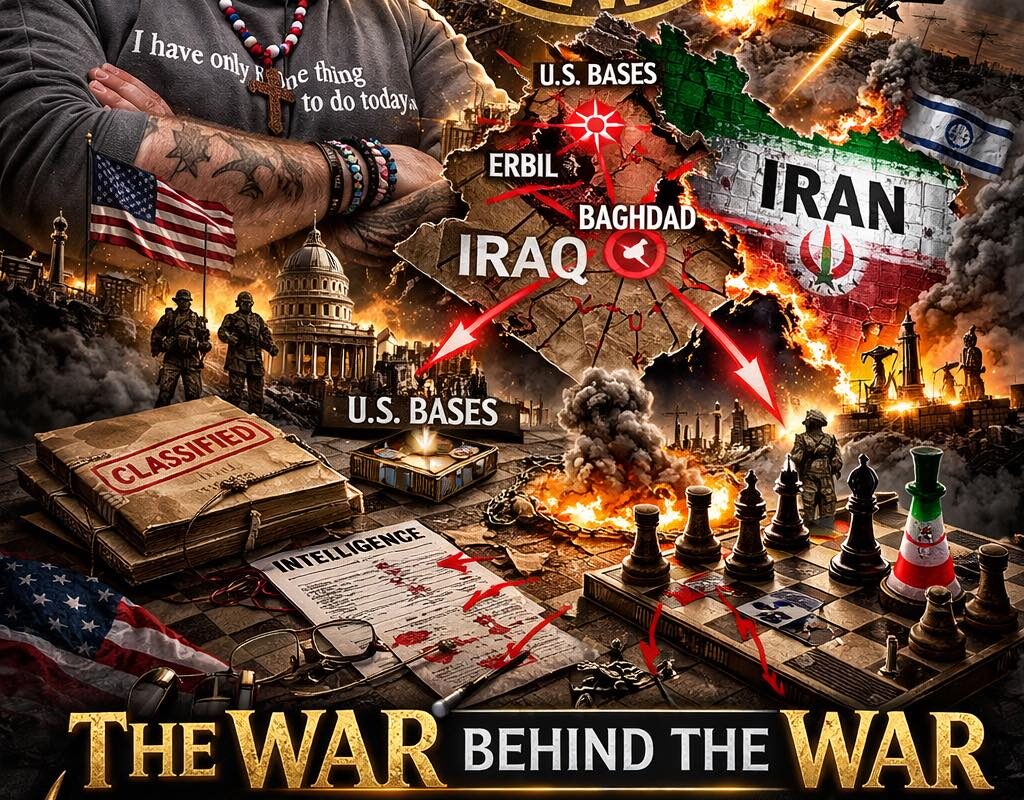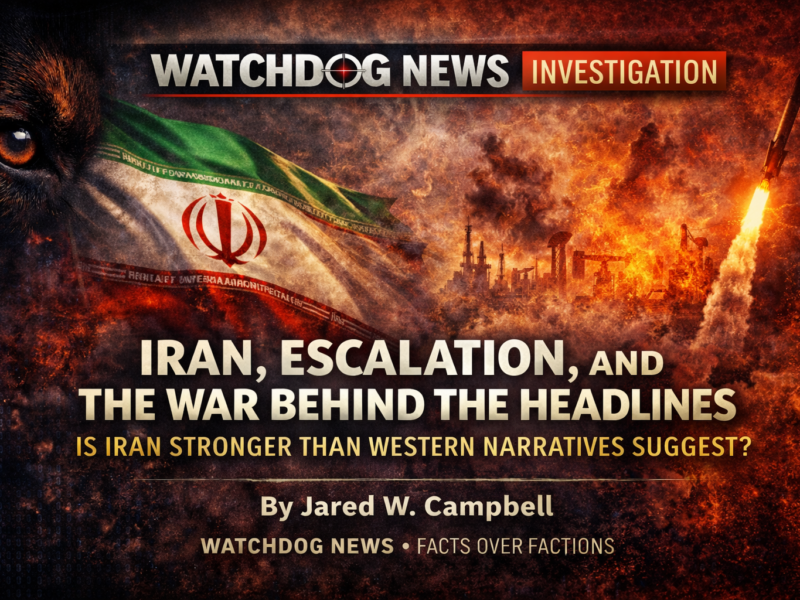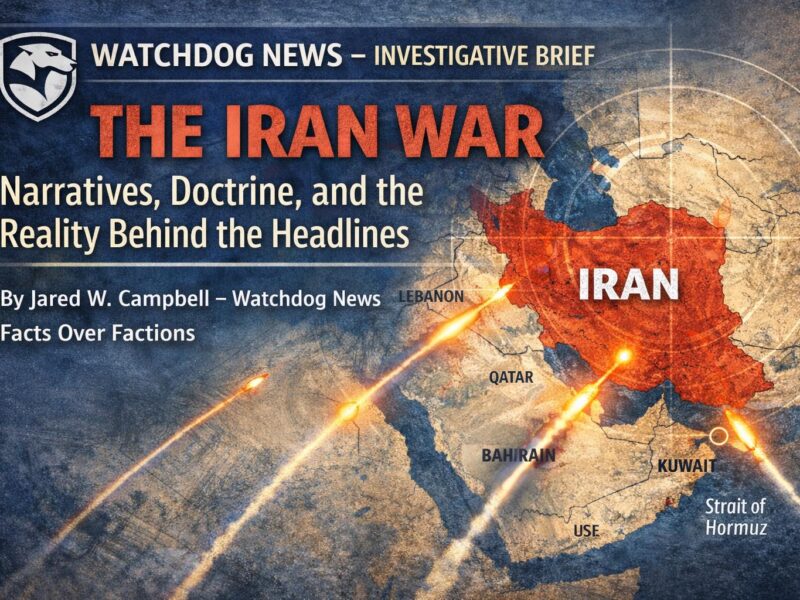


Douglas MacGregor says Iran is stronger than Western headlines suggest.
But what’s verifiable — and what remains in the fog of war?
In modern conflict, missiles destroy infrastructure.
Narratives shape legitimacy.
Full analysis at Watchdog News.
#FactsOverFactions
War in the Gray Zone
What Douglas Macgregor Claims — What We Can Verify — and What Still Lives in Narrative Fog
By Jared W. Campbell — Watchdog News
Facts Over Factions
Who Is Douglas Macgregor — And Why This Matters
Colonel Douglas Macgregor (U.S. Army, Ret.) is a decorated combat veteran, military strategist, author, and former senior adviser within the U.S. defense apparatus. He has long been critical of prolonged U.S. interventionism and regime-change wars, arguing that Washington often misreads civilizational states and overestimates the power of air campaigns. He appeared on the Glenn Diesen YouTube podcast channel. Diesen is a professor of Russian International affairs with a primary focus on geoeconomics.
He is not a random pundit.
He is also not an official spokesperson for current U.S. policy.
That distinction matters.
When a former insider speaks during an active conflict — especially one as volatile as this — his analysis can shape perceptions globally. But perception is not proof. And in modern war, numbers travel faster than verification.
The Watchdog does not dismiss claims because of who makes them.
The Watchdog examines them because of what they imply.
Watchdog reliability rating: This transcript is low-confidence for factual claims. Roughly ~25% of its specific, checkable statements are confirmed in reliable reporting; many key details are unverified, and at least two notable claims are contradicted by official or authoritative sources (e.g., Incirlik strike denial; inflated UAE-Indian population figure).
Colonel Douglas Macgregor offers a strategic critique of U.S. policy and escalation dynamics. His structural arguments about logistics, market reaction, and endurance warfare are historically grounded.
However, several precise battlefield claims (e.g., number of bases struck, aircraft losses, casualty figures) remain unverified through independent reporting.
Strategic theory ≠ confirmed battlefield data.
Facts over factions.
Part I — The Core Claims
Macgregor’s interview makes several high-impact assertions:
- Iran has struck dozens of U.S. and regional bases.
- Western air defenses are being overwhelmed by low-cost drones and advanced missiles.
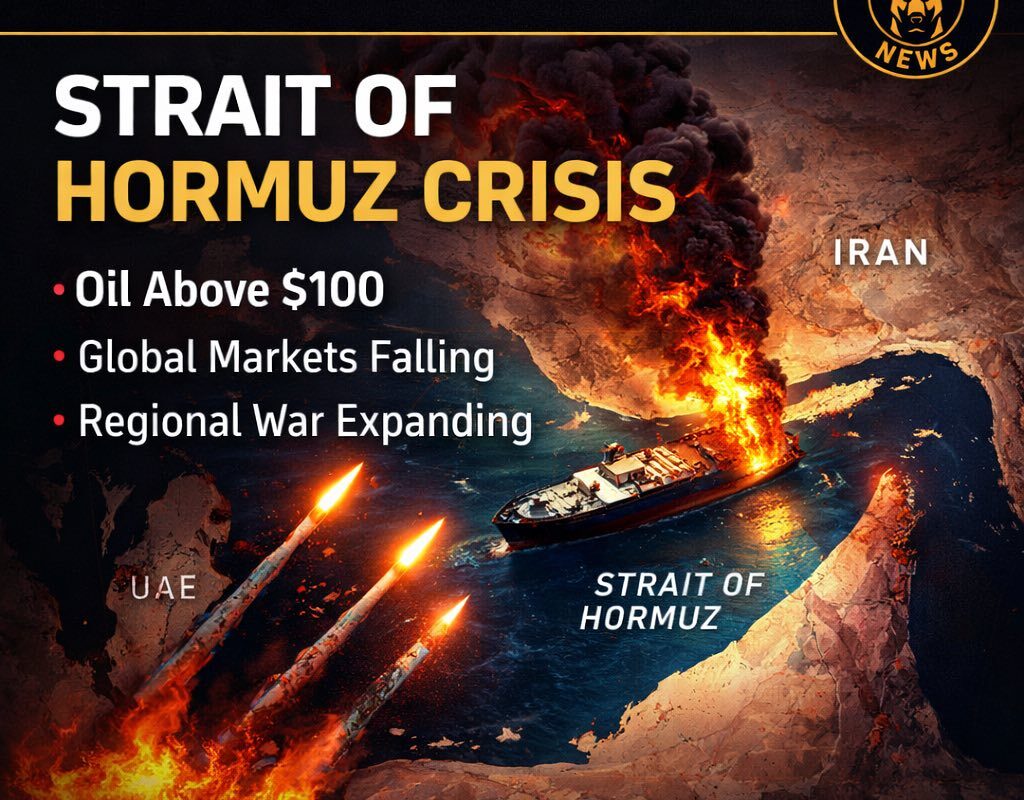
- Oil markets spiked sharply, signaling regional economic catastrophe.
- U.S. casualties may be higher than officially acknowledged.
- Israel initiated escalation, and the U.S. “joined late.”
- U.S. missile inventories are insufficient for sustained conflict.
- Iran only needs to survive to “win.”
- Western media is presenting an overly optimistic picture of the battlefield.
- The risk of nuclear escalation exists if Israel cannot stop missile attacks.
Some of these are structural strategic arguments.
Some are very specific battlefield claims.
Those must be separated.
Part II — What Is Verifiable vs. What Is Assertion
1️⃣ Oil Market Reaction
Historically, Gulf escalation triggers immediate risk premiums in oil markets.
That is well documented in past crises (1973, 1990, 2019 tanker attacks).
Oil moving sharply on the threat of disruption is plausible and consistent with energy market behavior.
Verdict: Structurally credible.
Exact percentage movements require verification of market data, but the mechanism is real.
2️⃣ Drone Saturation vs. Air Defense
Recent conflicts — especially Ukraine — have demonstrated that low-cost drones and saturation tactics can stress even advanced missile defense systems.
Air defense is not invincible. It is arithmetic:
- Interceptors are expensive.
- Attack drones are cheap.
- Saturation strains logistics.
This dynamic is real in modern warfare doctrine.
Verdict: Strategically plausible.
Specific base closures or total defense failure must be independently confirmed.
3️⃣ “27 Bases Struck” / “Three F-15s Downed.”
These are high-specificity claims.
When numbers are that precise, they should be traceable through:
- Official DoD statements
- Independent reporting (Reuters/AP-level)
- Geolocation / OSINT imagery
Without corroboration, these remain assertions — not verified facts.
Watchdog position:
Do not reject outright.
Do not accept without receipts.
4️⃣ U.S. Casualty Discrepancies
In wartime, casualty numbers often stabilize days or weeks after initial reporting. Fog of war is real.
However, alleging that casualties are significantly underreported requires evidence beyond suspicion.
Governments do manage messaging.
But extraordinary claims require extraordinary evidence.
Verdict: Possible but unverified.
5️⃣ “Iran Only Needs to Survive.”
This is not a battlefield claim — it’s strategic theory.
Historically, weaker powers often win by:
- Outlasting stronger adversaries
- Raising cost beyond political tolerance
- Turning endurance into legitimacy
Vietnam. Afghanistan. Iraq insurgency phases.
This framework is historically grounded.
But survival as victory depends on:
- Internal cohesion
- Economic endurance
- Military sustainability
- International backing
It is not automatic.
Part III — The Larger Strategic Question
MacGregor’s central thesis is not about missiles.
It is about narrative.
He argues:
- Western media overstate tactical success.
- Iran’s resilience is underestimated.
- The U.S. risks strategic exhaustion.
- Great power credibility is on the line.
This is where history matters.
World War I did not explode because of one assassination.
It exploded because mobilization, alliances, pride, and credibility traps locked leaders into escalation.
Modern crises escalate when:
- No side can back down without humiliation.
- Domestic audiences punish restraint.
- Military action outruns political planning.
That risk is real in any multi-state confrontation.
Part IV — Multiple Perspectives
U.S. Position
Likely objective: degrade capability, deter escalation, avoid full-scale regional war.
Public messaging emphasizes control and precision.
🇮🇱 Israeli Position
Preemption is framed as a survival doctrine.
Escalation may be seen as eliminating an existential threat.
Iranian Position
Survival framed as resistance.
Resilience messaging builds deterrence.
🌍 International View
Energy markets, shipping routes, and supply chains matter more than rhetoric.
If oil spikes and trade halts, economic pain spreads beyond the battlefield.
Part V — The Nuclear Escalation Question
MacGregor raises nuclear escalation risk if missile exchanges overwhelm conventional defenses.
That scenario remains hypothetical — but not unimaginable in extreme escalation ladders.
Strategic doctrine across major powers still treats nuclear use as a catastrophic last resort.
However:
Escalation psychology in prolonged war can change thresholds.
That is why de-escalation channels matter more than rhetoric.
Part VI — The Watchdog Assessment
MacGregor is strongest when he discusses:
- Logistical sustainability
- Market impact
- Civilizational resilience
- The limits of airpower alone
He is weakest when:
- Offering precise battlefield numbers without immediately cited sourcing
- Projecting certainty about hidden casualty counts
- Predicting inevitabilities (e.g., collapse, survival, regime outcomes)
The responsible Position is neither dismissal nor blind acceptance.
It is disciplined skepticism.
Final Watchdog Conclusion
War in 2026 is fought on two fronts:
- Physical battlefield
- Perception battlefield
Missiles destroy infrastructure.
Narratives shape legitimacy.
Right now, information moves faster than verification.
That does not mean Macgregor is wrong.
It means the public must separate:
- Strategic framework (often insightful)
from - Tactical specifics (which require receipts).
As a combat veteran, I understand this:
The early days of war are almost always misreported — in both directions.
Victory and collapse are both declared too early.
The Watchdog does not predict winners.
The Watchdog asks:
- What can be proven?
- What incentives shape the story?
- Who benefits if we believe one version over another?
Because in the gray zone between fact and narrative —
Truth survives only if someone insists on examining it.
👁️ Jared W. Campbell
Watchdog News — Facts Over Factions