

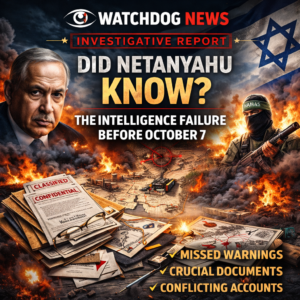
An investigation into intelligence warnings and systemic interpretation failures before October 7.
Did Netanyahu Know? Inside Israel’s “Walls of Jericho” Warnings and the October 7 Intelligence Breakdown
This story goes beyond just a single memo. It unveils a troubling trend: time and again, modern governments assert they possess detailed knowledge of potential threats. This rhetoric serves to remind us of the critical need for precise threat interpretation and the importance of accountability in their claims.
Here’s what we can confidently state, backed by published reports, official investigations, and documented statements:
- Israel’s security establishment had a Hamas attack blueprint—a roughly 40-page plan Israeli officials code-named “Jericho Wall / Walls of Jericho”—more than a year before October 7, 2023, and it described key elements that later occurred. [1]
- The New York Times reporting (syndicated and archived) describes the plan’s method: rockets, drones, disabling surveillance systems, and mass infiltration, including paragliders— “all of which happened.” [2]
- Whether Prime Minister Benjamin Netanyahu personally saw the full “Jericho Wall” plan remains contested, which should make the audience feel cautious about leadership transparency and accountability. [2]
- Other credible reporting claims that top political leadership was not shown the 2022 “Jericho Walls” file, pointing to failures in internal escalation and dissemination. [3]
- The Shin Bet’s own postmortem (as summarized in media coverage) says it knew about the Jericho Wall. Still, it wasn’t treated as a “reference threat,” and warning signs in summer 2023 weren’t linked to the documented plan. To clarify systemic causes, explore how internal processes or culture within agencies like the Shin Bet contributed to the ignoring or misinterpretation of warnings. [4]
- In February 2026, Israeli media reporting (as summarized across multiple outlets) alleges that Netanyahu received an April 2018 intelligence assessment about Hamas preparing capabilities for broad raids, while his office has denied he was briefed on the “Jericho’s Walls” document. These claims are high-impact, but the full underlying documents are not fully available in the open record. [5]
Watchdog bottom line:
The public record shows that the system issued a warning and repeatedly rated it as improbable or non-actionable—right up until the moment it became reality. The debate is not “did a plan exist?” It did. The debate is: who saw it, how it was interpreted, who had the duty to challenge that interpretation, and why accountability remains fragmented. [6]
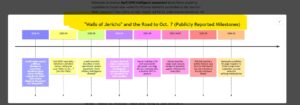
“Walls of Jericho” and the Road to October 7 (Publicly Reported Milestones)
What “Walls of Jericho” Was and Why It Still Matters
The 2023 report that reintroduced the world to “Jericho Wall” is not vague. It’s specific—and that’s what makes it explosive.
The New York Times described a translated Hamas plan obtained by Israeli officials, roughly 40 pages, that “did not set a date” but laid out a “methodical assault.” [2]
The plan’s operational outline is the part that haunts Israel’s public debate—because it reads like an October 7 preview.
A few words from that storyline, kept short and verifiable:
- “Hamas followed the blueprint with shocking precision.” [7]
- The plan included “drones to knock out the security cameras” and gunmen pouring in “in paragliders.” [2]
The Washington Post separately reported that Israeli intelligence had gathered evidence of large-scale planning and that some soldiers tried to sound alarms—suggesting this was not a single isolated document, but part of a broader warning ecosystem. [8]
The Watchdog point: “Walls of Jericho” wasn’t just a theory. It was a blueprint that sat inside a system that decided it couldn’t happen.
That is the core failure pattern.
The “Did Netanyahu Know?” Question: What Evidence Supports and What Remains Unproven
This is where Watchdog must be disciplined, because “Netanyahu knew” has become a slogan—used both to demand accountability and to assign blame without proof.
What major early reporting did and didn’t claim
The New York Times reporting (via syndication/archives) explicitly stated that it was unclear whether Netanyahu or other top political leaders had seen the “Jericho Wall” document. [2]
That matters because it means the most famous public “Jericho Wall” report did not establish a direct briefing from the prime minister.
The internal-flow problem: “the plan existed” is not the same as “the plan reached the top.”
Israeli media reporting, summarized by The Times of Israel, has described a serious escalation failure: Unit 8200 obtained the document in April 2022, but intelligence chiefs did not inform Israel’s most senior military and political leaders. [3]
Another Times of Israel report says an officer’s warning about Hamas onslaught planning in August 2023 was dismissed as a “pompous and unrealistic scenario,” and even scrubbed from what was presented upward. [9]
That supports a “systemic bottleneck” theory: warning signals existed. Still, the machinery that elevates warnings to executive urgency malfunctioned—or was resisted —which should make the audience feel the critical need for reform and oversight.
The 2018 contention: a new (2026) layer that shifts the ground
In February 2026, Israeli media reporting summarized across multiple outlets (citing Ynet) alleged that an April 2018 assessment warned of Hamas preparing for a broader, deep incursion, with distribution reaching senior defense/NSC channels tied to the prime minister. [10]
Those same reports describe a contradiction: Netanyahu’s office stated he “never received” and was never briefed on the “Jericho’s Walls” document. At the same time, Netanyahu later published a redacted 55‑page response to the State Comptroller that includes selective quotations and a heavy focus on blaming security bodies. [5]
Since the full alleged 2018 assessment isn’t broadly public in the open record right now, Watchdog treats this as high-impact, partially unverified: credible enough to report as “Israeli media alleges,” not strong enough (yet) to declare as a settled fact.
Claim vs. evidence table
| Claim | What supports it | Evidence strength |
| Netanyahu definitely saw the full 2022 “Jericho Walls” plan | Reporting that top political leadership did not see it suggests the opposite | Weak / not supported [3] |
| It was unclear whether Netanyahu saw the “Jericho Wall” document | The NYT report said it was unclear | Strong [2] |
| Intel chiefs withheld the 2022 plan from top leaders | Channel 12 / Times of Israel reporting | Strong [3] |
| Netanyahu was exposed to 2018 warnings about broad raids | 2026 reporting citing Ynet; corroborating reprints | Moderate (needs primary doc release) [10] |
| Netanyahu publicly shifted blame to the security establishment | Netanyahu’s published 55-page response, described by Ynetnews | Strong [11] |
Watchdog conclusion on the “did he know” question (as of public evidence):
We can’t honestly claim “Netanyahu knew the full Jericho Wall blueprint” based on the strongest open sources, because early major reporting made it unclear. Later Israeli reporting suggests senior leadership may not have been shown the 2022 file. But it is increasingly harder to argue that the system around him lacked knowledge of Hamas invasion concepts. The unresolved question is how much the political apex was reached, and when. [12]
The Breakdown: How a Detailed Plan Became “Not Relatable”
This is where the Watchdog story gets deeper than Netanyahu.
Because even if you removed Netanyahu from the equation entirely, the failure pattern still exists. A detailed
- A detailed scenario exists
- Analysts label it as low probability
- Leadership accepts the assessment
- the “unlikely” becomes the actual
“Not a reference threat” and the concept trap
A major 2025 Shin Bet summary, as reported by Ynetnews, admits the agency knew of the plan but did not treat it as a formal “reference threat.” [13]
The Guardian’s reporting on Shin Bet’s findings captures the same underlying failure: “The plans were not viewed as a relatable threat.” [14]
That phrase— “not relatable threat”—is basically intelligence culture in one sentence.
It means we could picture it on paper, but we didn’t believe it would happen now.
Signals were there; interpretation failed.
Shin Bet said “weak indicative signs” in summer 2023 were not connected to that threat picture, and it raised an alert the night before the attack after Hamas militants activated Israeli SIM cards. [14]
Meanwhile, AP reporting documented Hamas conducting overt training and simulation content in public—an example of “signals in plain sight.” [15]
So what failed?
Probably not a collection alone. More likely: interpretation, escalation, and institutional assumptions.
The “comfort bias” explanation (academics and insiders)
Former Israeli National Security Council head Eyal Hulata told The Daily Beast he never saw the Jericho Wall and said, “I would want to say it must have. But I cannot.” [16]
That quote matters because it reflects what intelligence scholars often describe: leaders don’t read every threat paper; they rely on systems to elevate what matters. When that system becomes comfortable—when it believes deterrence is working—you get catastrophic surprise.
Watchdog translation: the failure wasn’t a lack of information. It was a failure of belief.
Accountability and the Politics of Blame
This story persists because Israel’s post‑Oct. 7 accountability has been fragmented—multiple internal probes, intense public pressure, and ongoing political conflict over who controls the narrative.
Reuters reported that Israel’s State Comptroller urged Netanyahu and the IDF chief to cooperate and framed it as a “public right” to accountability, while many lacked adequate cooperation. [17]
The Jerusalem Post reported the State Comptroller demanded documents and transcripts from the Prime Minister’s Office tied to security meetings and decision-making in the years before the war. [18]
And in February 2026, Netanyahu published his 55‑page response to the comptroller and blamed the security establishment, asserting they did not convey information pointing to a different reality—even though, he said, indicators existed. [11]
That publication triggered political backlash. The Jerusalem Post reported opposition leader Yair Lapid accused Netanyahu of “tendentious editing” of security protocols, framing it as a serious breach. [19]
Watchdog note: When leaders release selective documents, it can be transparency—or narrative warfare dressed as transparency. The difference is whether the underlying record is accessible to independent review.
Watchdog Take: What Would Actually Settle This
Here are the documents that would materially answer the “did Netanyahu know” question and the broader “why did the system fail” question:
- The distribution list and briefing record for the 2018 assessment are alleged to raise the “broad deep incursion” scenario (if it exists as described). [20]
- Chain-of-custody and dissemination logs for the 2022 “Jericho Wall(s)” file inside Unit 8200, Southern Command, and IDF Intelligence Directorate. [21]
- The Shin Bet’s “reference threat” classification documents and the criteria used to decide the Jericho Wall were not treated as operational. [4]
- Minutes or transcripts from NSC / security cabinet discussions where Hamas intent and “deterrence” assessments were reviewed, including the Sept. 2023 assessments Netanyahu quoted. [22]
- The full, unredacted sections of Netanyahu’s comptroller response (to the extent legally releasable), with the original context for every quoted excerpt. [23]
Watchdog questions that follow the documents: – If a plan is deemed “unlikely,” what is the minimum defensive posture required anyway?
– Who had the authority to elevate the plan to “reference threat,” and why didn’t it happen? [4]
– Did the system rely on deterrence assumptions so heavily that it dismissed contradicting indicators? [24]
– Was information blocked upward—or filtered out as “not credible”? [25]
👁️ WATCHDOG SIGNATURE
At Watchdog News, the mission is simple: follow the facts wherever they lead, question power wherever it operates, and separate signal from noise in an age of competing narratives.
Facts Over Factions. Always.
— Jared W. Campbell
Watchdog News
Facts Over Factions!

Watchdog News Original Logo