

Separating verified influence from political narratives in U.S.–Middle East policy.
Israel, Iran, and the Pressure Question: What We Can Prove About U.S. Policy and AIPAC Money
Executive Summary
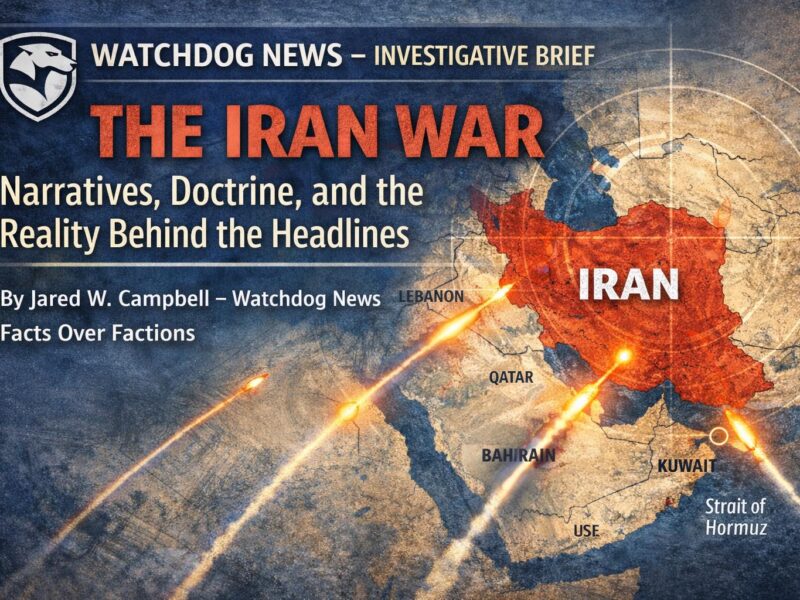
Mexico isn’t the only place where power shows up in layers. The Middle East is the same story—just with higher stakes and fewer receipts. Tonight’s Watchdog question is simple:
Is the Trump[1] administration being pressured by Israel[2] over recent Iran[3] developments—and how much money does Trump actually receive from AIPAC[4]?
Here’s what the public record supports—cleanly, without theater:
- Israel is visibly pushing for broader Iran talks (missiles and proxy networks, not just nuclear limits). That’s not a rumor; it’s in Netanyahu’s own framing ahead of the Feb 11 White House meeting. [5]
- Trump publicly signaled he’s not simply taking Israel’s preferred approach—saying he “insisted” talks continue—while also warning about potential force if diplomacy fails. [6]
- US military signaling has escalated sharply, including reporting that the U.S. deployed F‑22s to Israel—a step The Wall Street Journal[7] described as a first—alongside a major U.S. regional force posture while talks proceed. [8]
- On the money question: As a matter of campaign-finance structure, AIPAC itself doesn’t “write checks” to a candidate; contributions come through affiliated political committees (notably AIPAC PAC). [9]
- In itemized PAC-contribution listings for Trump’s 2024 campaign committee (Never Surrender, Inc.) and his leadership PAC (Save America), AIPAC PAC does not appear. In other words, direct PAC contributions from AIPAC PAC to those Trump committees are not evidenced in those listings. [10]
- AIPAC-linked election influence is strongest in Congress, not the Oval Office ledger. AIPAC PAC reported $35.8M in receipts in the 2024 cycle; the AIPAC‑affiliated super PAC United Democracy Project reported $42.9M in receipts and $31.4M in independent expenditures in 2024—overwhelmingly in congressional races. [11]
Watchdog conclusion (based on what’s provable): Israel is publicly advocating for expanded Iran negotiations through diplomatic messaging and direct engagement with U.S. leadership. The claim that “AIPAC pays Trump” is usually sloppy framing. The more defensible statement is: Pro‑Israel money and lobbying power primarily shape Congress and the broader policy environment Trump operates inside—not a direct personal “AIPAC paycheck.” [12]
Verified Timeline of the Current Iran Track
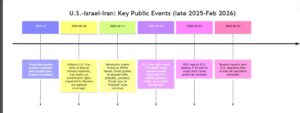
U.S.–Israel–Iran: Key Public Events (late 2025–Feb 2026)
This timeline focuses on reportable, attributable events from late 2025 to February 2026, using major wire services and outlets, as well as primary public records.
Feb 6 (reported): Indirect talks in Oman[13]’s capital Muscat were described as a restart point for diplomacy, with reporting that Iran emphasized a “right to enrich uranium,” while missile limits were not raised in that round (as summarized in reporting carrying Reuters[14] content). [15]
Feb 11 (confirmed meeting + public framing): Benjamin Netanyahu[16] arrived with a message: expand negotiations beyond nuclear issues to include missiles and support for regional militant groups. Trump later posted: “I insisted that negotiations with Iran continue…” (quote kept short). [6]
Feb 25 (talks + pressure posture): Reporting describes the U.S. and Iran entering a third round of talks in Geneva[17] amid a major U.S. military buildup; AP reported that Trump deployed warships and aircraft while talks proceeded. [18]
Feb 25 (U.S. sanctions): Reuters reported that the U.S. announced sanctions targeting Iranian oil and entities linked to sanctions evasion. (Public sanctions actions are a measurable form of “economic warfare” short of direct kinetic conflict.)
Feb 25 (military signaling through Israel): The Wall Street Journal reported the U.S. deployed F‑22 jets to Israel for the first time, framing it as a major deepening of operational integration amid Iran tensions. [19]
How Israel Pressures Washington: The Channels That Actually Matter
If you want a serious watchdog, read on “pressure,” you don’t start with conspiracy. You start with mechanisms—the ways influence is applied in real life, some legitimate, some ethically gray, some simply undisclosed.
Public pressure
“Public diplomatic advocacy is the most visible and verifiable channel of influence.”
Netanyahu made clear before meeting Trump that negotiations should include missile limits and curbs on support for armed groups (not just enrichment). That’s Israel stating its conditions in public—a typical example of allied policy advocacy, with strategic messaging attached. [20]
Trump’s public posture is two-layered: he signals openness to diplomacy while warning Iran that failure has consequences. That stance may overlap with Israel’s interests, but overlap is not proof of control. It is proof that the administration is keeping both options—deal or force—on the table in public. [21]
Private diplomacy
Private pressure is harder to document, and that is exactly why it matters.
Reporting indicated the Feb 11 Trump–Netanyahu engagement was unusually closed to reporters, with Trump describing the outcome via social media rather than press Q&A. Netanyahu’s office said they agreed to continue “close coordination.” [22]
That’s not a smoking gun. It’s a familiar dynamic: allied leaders negotiate behind closed doors, then selectively release narrative framing. Watchdog note: private diplomacy creates the widest gap between what happened and what the public can audit.
Intelligence sharing and threat framing
This is an invisible engine. It’s also inherently hard to verify because much of it is classified.
Still, we can observe second-order indicators: escalatory postures and stated negotiating demands. AP reporting on the Geneva talks explicitly paired diplomacy with military pressure tactics. [18]
Israel can shape U.S. threat framing through intelligence coordination, but the public can usually infer it only from outcomes (sanctions packages, target allocations, force posture) rather than from documents.
Military signaling and operational integration
“This is where influence can become structural through long-term military and strategic coordination. “The WSJ reported the U.S. deployed F‑22s to Israel—described as a first—expanding U.S. defensive and offensive options and increasing Israel’s value as a staging partner. [19]
Whether Israel “pressured” the U.S. into that move is not provable from public reporting alone. What is provable is that U.S. options are now more tightly coupled to Israel’s geography and basing realities, which changes leverage in future crisis decisions.
Congressional lobbying and the policy environment Trump inherited
Presidents don’t operate in a vacuum. Congress shapes sanctions authorities, aid flows, arms transfers, and political permission structures.
This is where AIPAC[4] operates most effectively: building durable, bipartisan support across hundreds of lawmakers—creating a “floor” under U.S.–Israel policy that is difficult for any administration to ignore. The financing and lobbying system doesn’t need to control Trump directly to constrain the space he moves in.
The Money Trail: What Trump Receives vs. What the System Funds
Let’s separate three things the public constantly mixes:
1) AIPAC (lobbying organization)
2) AIPAC PAC (a federal PAC making candidate contributions)
3) United Democracy Project (UDP) (a super PAC aligned with AIPAC’s political ecosystem)
What the records show about AIPAC PAC’s scale
AIPAC PAC’s 2024-cycle committee summary shows $35,811,463 in total receipts and $36,725,509 in total spending. [23]
That’s not “a donor.” That’s an institution.
What the records show about Trump’s direct receipts from AIPAC PAC
Here’s the part that needs to be said plainly because the internet refuses to say it plainly:
“This finding refers specifically to publicly itemized PAC-to-committee contributions reviewed in Federal Election Commission records and does not exclude support from individual donors or independent expenditures operating elsewhere in the political system.”[10]
“Claims that ‘AIPAC pays Trump’ require documented contribution records. The itemized PAC filings reviewed here do not show direct AIPAC PAC contributions to Trump campaign committees.”
And on the specific PAC-to-committee pathway most people imply, the record shown here does not support it. [10]
That does not mean pro-Israel donors don’t support Trump through other channels. It means the “AIPAC writes Trump checks” framing is usually inaccurate.
What AIPAC PAC does fund: lawmakers, on both sides
AIPAC PAC contributions are usually $5,000 increments to candidate committees. Here is one documented example, itemized:
- Magaziner For Congress received $5,000 (Oct 25, 2024) and $5,000 (Jul 23, 2024) from “American Israel Public Affairs Committee Political Action Committee” (plus an earlier $5,000 in 2022). [24]
That’s what this influence looks like in real life: distributed, persistent, and normalized.
AIPAC’s allied super PAC ecosystem (UDP)
UDP’s committee summary shows in the 2024 cycle: $42.9M receipts, $54.9M spending, and $31.4M in independent expenditures—primarily in congressional races. [25]
This matters because independent expenditures are legally defined as spending not coordinated with campaigns. As the Federal Election Commission[26] explains, an independent expenditure is not made “in consultation or cooperation” with a candidate (short quote). [27]
In Watchdog terms, even when the spending is “independent,” it still shifts the political landscape Trump governs inside.
Quick table: what is evidenced vs what is commonly claimed
| Question people ask | What’s verifiable from the record shown here | Evidence strength |
| “Did AIPAC PAC donate to Trump’s 2024 campaign committee?” | AIPAC PAC does not appear in itemized PAC listings for Never Surrender, Inc. [28] | Strong (negative finding within itemized list) |
| “Did AIPAC PAC donate to Save America (Trump’s leadership PAC)?” | AIPAC PAC does not appear in itemized PAC listings for Save America. [29] | Strong (negative finding within itemized list) |
| “Does AIPAC influence U.S. policy anyway?” | AIPAC PAC is a large-scale contributor; UDP spends heavily in congressional races; both shape Congress. [30] | Strong |
| “Is Israel pressuring Trump on Iran?” | Israel publicly pushes expanded talks; Trump publicly signals his own line while keeping coercive options. [31] | Moderate (pressure is visible; causality is harder) |
Legal and Ethical Context: The Lines Everyone Argues About
Foreign influence vs domestic lobbying
Foreign influence has legal guardrails; domestic lobbying is a legally protected political activity.
Under the DOJ FARA Unit[32], FARA requires certain agents of foreign principals to disclose relationships and activities (short quote). [33]
AIPAC is a U.S. lobbying organization operating inside that domestic framework (separately from whether critics believe it should be treated differently). The legal system distinguishes “foreign agent” status from U.S.-based advocacy outfits unless they meet definitional triggers under FARA.
Campaign finance: foreign nationals and “things of value.”
Federal law prohibits foreign nationals from contributing to U.S. elections. The statute (52 U.S.C. § 30121) bars foreign nationals from making contributions or expenditures and from soliciting or accepting them. [34]
The CFR implementing rule also limits foreign nationals’ participation in decision-making about election-related spending. [35]
Watchdog point: This is why “Israel paid for X” claims require receipts, not vibes. The legal regime is real, and violations are prosecutable. [36]
Super PACs, coordination, and the “wink and nod” problem
The rule is simple on paper and messy in practice:
- If money is truly independent, it’s not capped like contributions. [37]
- If it’s coordinated, it becomes an in-kind contribution and can trigger limits and restrictions. [38]
This is the structural tension: modern politics runs on outside spending while the law hinges on proving coordination—a high bar.
Competing Perspectives: What Each Side Wants You to Believe
Israeli government perspective
Israel frames expanded Iran negotiations as a regional security necessity: missiles and proxy networks are integral to the threat picture, not optional add-ons. Netanyahu’s office telegraphed that before the White House meeting. [20]
Trump administration perspective
Trump is projecting leverage: diplomacy backed by force posture. That posture is evident in the military buildup described during the Geneva talks and in reporting on the deepening U.S.–Israel operational integration. [39]
Reuters also reported that Trump’s envoy was pushing for a deal that lasts “indefinitely,” reflecting a maximalist demand for durability. [40]
AIPAC perspective
AIPAC generally presents itself as supporting pro–U.S.-Israel relationship candidates and policies as a matter of alliance security. The measurable footprint, as reflected in public records, is through affiliated political spending and lobbying activity. [30]
Independent analysts and watchdog concerns
The watchdog critique isn’t “Israel controls America.” The stronger critique is structural:
- Heavy congressional alignment can reduce policy flexibility.
- Military integration can narrow basing and escalation choices.
- A permanent crisis posture (sanctions + deployments) can become the “new normal.” [41]
Misinformation Risk: What to Verify Before You Repeat It
This story is an easy target for propaganda because it blends three inflammatory ingredients: war, money, and foreign influence.
Watchdog verification rules for this topic:
- Don’t say “AIPAC gave Trump $X” unless you can point to an FEC itemization showing Trump committees receiving it. The itemized PAC listings referenced here do not show that. [10]
- Don’t claim “Israel forced” U.S. actions unless a primary statement or credible reporting documents direct conditionality. What’s provable is Israel’s stated demands and U.S. posture—not the full causal chain. [42]
- Separate “pressure” from “coordination.” Pressure is normal in allied behavior; coordination can be lawful diplomacy or unlawful election conduct, depending on the facts and venue. [43]
Watchdog Questions and Transparency Requests
- State Department / DoD FOIA: cables or memos referencing negotiation scope (nuclear vs missiles vs proxies), and any non-classified policy guidance around the current talks posture. [44]
- DoD disclosures: basing agreements, temporary deployments, and force posture rationale connected to Israel-based operations (to the extent releasable). [19]
- FEC audit trail: publish direct links to committee IDs and cycle pages for (1) Trump committees and (2) AIPAC PAC and UDP—so readers can self-verify. [45]
- Congressional pressure map: track which members publicly push expanded Iran conditions and whether major pro-Israel PAC spending is concentrated around those members’ reelections.
By: Jared W Campbell- Watchdog News
Facts over Factions!
Watchdog signature:
At Watchdog News, I’m not here to tell you what to think. I’m here to show you what can be proven—because in foreign policy, the most dangerous stories are the ones built on assumptions instead of evidence.