

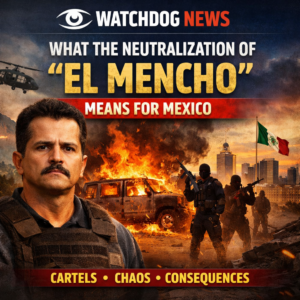
Removing a cartel leader does not always dismantle a cartel’s system.
What the Neutralization of “El Mencho” Means for Mexico
A kingpin is gone — but the system he built is still running
By Jared W. Campbell — Watchdog News
Facts Over Factions
Introduction — The headline is “kingpin dead.” The reality is “system stress test.”
Mexico just absorbed what looks like one of the biggest counter-cartel wins in a generation: the reported killing of Nemesio Rubén Oseguera Cervantes (“El Mencho”), leader of the Jalisco New Generation Cartel (CJNG), in a Mexican military operation reported on February 22, 2026, in Jalisco.
Then Mexico got the second message — the one cartel ecosystems always send after a high-value target drops:
Burning roadblocks. Coordinated disruption. Multi-state chaos.
That’s why Watchdog reporting starts with the uncomfortable truth:
A “high-value target” hit can be a real operational win and the opening bell for a dangerous transition period — violence spikes, factions move, rivals probe, propaganda floods the zone, and civilians get trapped in the middle.
This isn’t only a crime story.
It’s a state-capacity story.
It’s a test of whether the strategy is built for more than removal.
1) What’s reported about the February 22 operation — and why the U.S. role matters
Based on the reporting that has been provided, Mexico’s Secretariat of National Defense (SEDENA) confirmed Oseguera was wounded and later died during an air transfer.
The reporting you provided also describes U.S. support as intelligence cooperation—not boots on the ground—with Mexico describing “complementary information” that contributed to the success.
That detail matters because it sits at the intersection of two pressures:
- Mexico: deliver security results without looking subordinated to Washington.
- United States: escalate pressure on fentanyl networks, including a policy drift toward treating cartel power through a counterterror lens.
And the aftermath was immediate: arson attacks, highway blockades, burning vehicles, and assaults on government-linked targets across multiple states.
Watchdog note on numbers (and why you say it out loud): early casualty totals in fast-moving security events are often inconsistent across outlets because some count only one State, others count multi-state, and categories blur (cartel dead vs. soldiers vs. National Guard vs. civilians). That volatility is normal — and pretending it isn’t is how propaganda wins.
2) The detail everyone keeps asking: “How did they find him — was it a lover?”
One of my research pieces discussed a breakthrough in human intelligence, tied to a romantic partner, via surveillance of a person close to her (described as a bodyguard/confidant). That monitoring reportedly led investigators to a mountain refuge near Tapalpa, where the presence was confirmed, followed by a rapid raid.
Whether that exact “lover angle” holds up across final official disclosures or not, the bigger point is this:
Most kingpins don’t fall because tech is magic. They fall because human routines get mapped.
Movement, meetings, couriers, medical needs, family ties, trusted inner-circle patterns — that’s where “untouchable” becomes trackable.
So the Watchdog question isn’t gossip. It’s governance:
What intelligence method was used — and what blowback hits civilians when retaliation starts?
3) The retaliation wasn’t random — it was communication (and it had a body count)
For reporting purposes, this wasn’t “chaos.”
This was a message campaign using fire and paralysis:
- burning roadblocks
- arson on businesses
- trucks on highways / key corridors frozen
- coordinated multi-state disruption
From the Reuters reprint I was able to locate, Mexican officials discussed cartel-linked accounts amplifying disinformation after the killing. At the same time, Security Secretary Omar García Harfuch publicly said that accounts were being identified for deeper investigation, and President Claudia Sheinbaum said there were “many, many fake news stories” circulating.
- 25 National Guard members killed (as reported in your past coverage)
- dozens of cartel fighters killed, and 30 cartel members killed (as reported in your past coverage)
- 70+ arrests across seven states (as reported in your past coverage)
When a cartel can answer a leader’s death by setting regions on fire, that’s not just criminal violence — it’s a power demonstration aimed at three audiences:
- The State: “You took the boss — we can still freeze your cities.”
- Rivals: “Don’t test us during succession.”
- Civilians: “Your government can’t protect you everywhere.”
4) CJNG isn’t a street gang — it’s a diversified enterprise with logistics, ports, and multiple revenue streams
This is where casual coverage stays shallow, and Watchdog goes structural:
CJNG is a networked, multi-revenue enterprise. Drugs are the flagship product, but not the only one.
This report specifically flags a U.S. government description of CJNG’s revenue and portfolio — including fuel theft, timeshare fraud, migrant smuggling, corruption, and control of logistics terrain, such as the port of Manzanillo.
I can support the broader “diversified enterprise” point with reputable reporting, including coverage of CJNG’s expansion, geographic reach, and the U.S. tracking of CJNG-linked financial networks and activities.
Watchdog translation: leadership loss doesn’t kill an organization designed with redundancy:
- regional cells
- finance operators
- logistics managers
- enforcers
- corruption channels
- external suppliers
So after a kingpin hit, the real vulnerability isn’t “the face.”
It’s whether the State can disrupt:
- financing + laundering
- precursor imports + trafficking logistics
- port access + transportation corridors
- corruption pipelines
- weapons sourcing + recruitment
That’s the difference between a symbolic Researchand a structural one.
5) Decapitation strategy — what research says tends to happen next
Mexico has seen versions of this movie before.
And the literature is consistent on one brutal reality:
Removing leaders can trigger fragmentation and competition — often creating more groups, not fewer, fighting over territory and revenue.
Two research conclusions that matter:
- A 2015 peer-reviewed study found that violence can drop briefly after removals, but rise longer-term as markets and factions reorganize, with the nuance that arrests can have different effects than killings.
- More recent research connecting kingpin removals to the emergence of smaller groups, shifting conflict toward decentralized competition.
On that second point, the Esberg finding is widely circulated in academic summaries, and the Reuters reprint I found also references her work and the “control of the country” framing around cartel narrative operations.
Now connect that back to your key Watchdog insight:
Oseguera was reportedly killed, not captured.
That matters because a killing can remove:
- the possibility of a public trial
- prolonged intelligence extraction
- negotiated off-ramps
- courtroom exposure of financial/political links
So Watchdog doesn’t celebrate headlines—watchdog measures outcomes.
6) The propaganda layer — violence on the ground, chaos online
Cartels don’t only fight with guns anymore.
They fight with:
- intimidation
- spectacle
- narrative
- platform amplification
- misinformation floods
And now — with AI tooling — that informational warfare gets faster and more scalable.
From the Reuters reprint I located, Sheinbaum’s “many, many fake news stories” line is the exact tell: the State isn’t only battling armed retaliation; it’s battling perception collapse in real time.
Watchdog translation:
Perception shapes behavior:
- whether civilians stay home or flee
- whether the business shuts down
- whether supply chains pause
- whether rivals see an opportunity
- whether the public believes the State sets the rules
7) What comes next — three scenarios that cover reality without pretending certainty
No serious analyst claims CJNG disappears because a leader is gone.
The question is how the system rebalances.
Scenario 1 — Managed succession, continued cohesion
CJNG has an incentive to stabilize: fragmentation makes them easier to target and invites rivals to seize routes.
But cohesion requires a successor with legitimacy across regional power centers — and that’s not guaranteed.
Scenario 2 — Fragmentation and localized wars
This is the risk your research keeps pointing to: regional commanders competing, splinter groups emerging, rivals launching offensives, violence shifting patterns rather than vanishing.
Scenario 3 — Financial strangulation becomes the battlefield
In this report, I also flagged a key modern shift: the U.S. toolbox increasingly treats cartel networks as systems to be pressured through sanctions and network disruption—essentially, economic warfare applied to criminal enterprises.
But Watchdog also says the quiet part:
If financial pressure isn’t paired with domestic stabilization and anti-corruption enforcement, flows don’t disappear — they mutate into harsher local extraction:
- extortion
- kidnapping
- fuel theft
- municipal intimidation
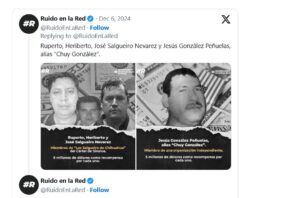
8) “Who’s next?” — the successor problem is not a sidebar, it’s the story
- Juan Carlos Valencia González (“El Pelón”) — described in your reporting as a likely successor figure
- Rosalinda González Valencia (“La Jefa”) — described in your reporting as a financial influence figure
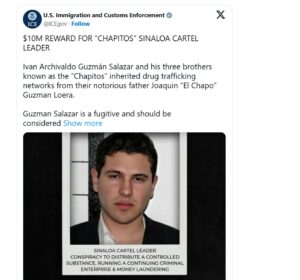
- Iván Archivaldo Guzmán Salazar (“El Chapito”) — linked in your reporting to Sinaloa leadership and fentanyl operations
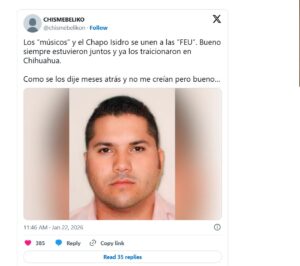
- Fausto Isidro Mesa-Flores (“El Chapo Isidro”) — listed in your reporting as a high-priority fugitive figure
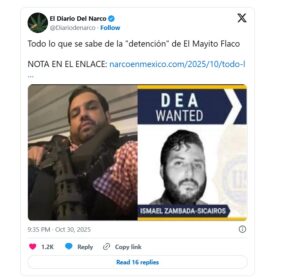
- Ismael Zambada Sicairos (“El Mayito Flaco”) — tied in your reporting to factional struggle dynamics
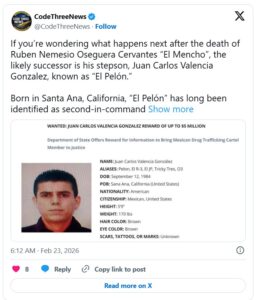
If you’re wondering what happens next after the death of Ruben Nemesio Oseguera Cervantes “El Mencho”, the likely successor is his stepson, Juan Carlos Valencia Gonzalez, known as “El Pelón.”
Cartels operate less like armies led by one general… and more like corporations with succession plans.
9) The Watchdog questions Mexico’s public deserves answers — before the narrative hardens
- What evidence will authorities release that CJNG’s financial and operational nodes are being dismantled — not just leadership removed?
- Will the strategy prioritize seizures of: assets, ports, fuel theft networks, and corruption channels?
- Will U.S. counterterror framing change the operational landscape through sanctions, prosecutions, intelligence fusion, or pressure for escalation?
- How will Mexico counter cartel-driven misinformation (including AI-enhanced content) without sliding into broad censorship that harms legitimate reporting?
- What’s the protection plan for civilians and infrastructure during the likely turbulence of a succession?
Because governments love the metric, they can “win” on paper.
Watchdog asks for the metric that protects people.
The State won a battle. Now comes the harder test.
Removing “El Mencho” (if the reporting holds) is a high-impact strike against a leader who built one of Mexico’s most powerful criminal enterprises.
But the retaliation — and the propaganda wave — signals what the next phase actually is:
The contest shifts from a search to an chasetional struggle over territory, legitimacy, and whether the public believes the State — not the cartel — sets the rules.
Mexico’s leadership has urged calm and emphasized coordination, while distancing itself from earlier cycles in which removals led to fragmentation and spiraling violence.
That’s the central tension of the moment:
Can Mexico dismantle cartel power without repeating the pattern in which removal leads to splintering?
Watchdog’s bottom-line principle is simple:
A leader can be neutralized in a day.
A system — economic, political, informational — takes longer to dismantle.
And the public deserves to know which one the government is actually equipped to do.
At Watchdog News, the goal is not to inflame — but to observe the patterns others ignore.
Because power doesn’t only survive through men.
It survives through systems.
— Jared W. Campbell
Watchdog News | Facts Over Factions