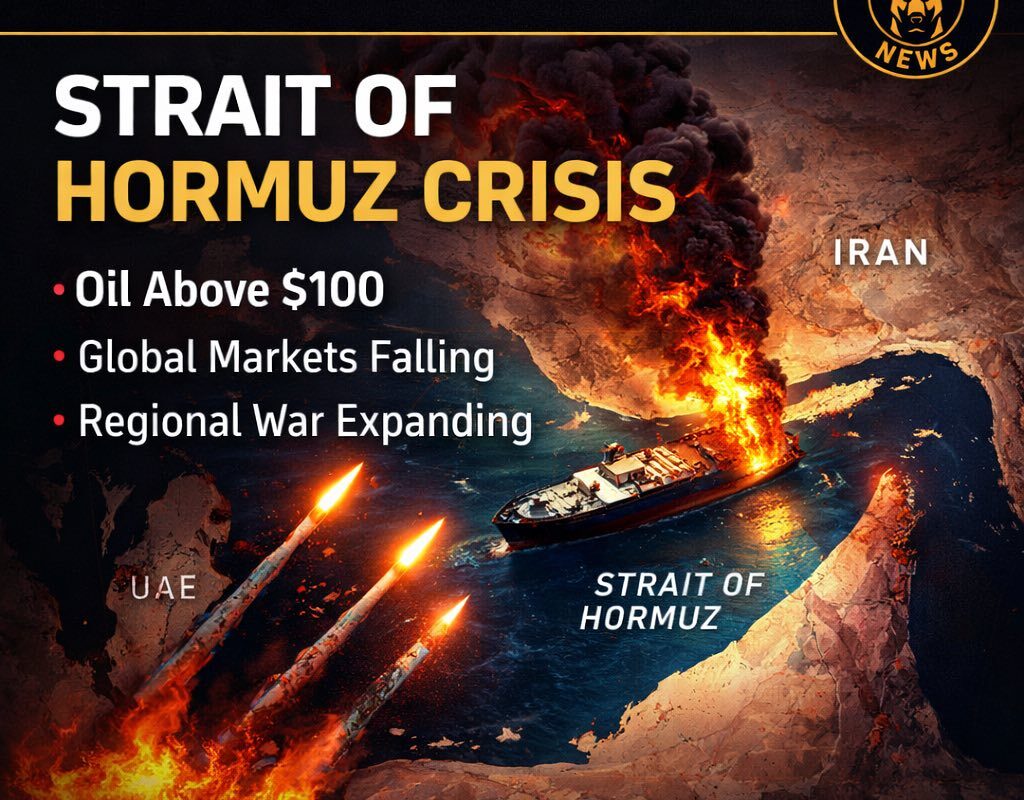


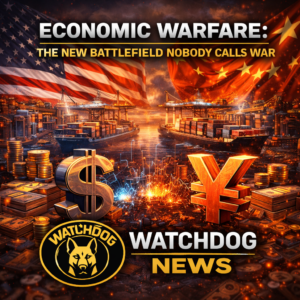
Modern geopolitical conflict increasingly occurs through trade systems, sanctions, and economic pressure rather than military force.
Economic Warfare Is the New Battlefield Nobody Calls War
Today’s three stories were really one story
By Jared W. Campbell — Watchdog News
Facts Over Factions
This morning, we tracked the expansion of AI surveillance—how capability spreads faster than oversight. Midday, we tracked emergency powers—how temporary authority becomes routine authority. Tonight’s anchor is the third layer most people feel but rarely name:
economic warfare—conflict waged through the systems that move money, technology, and trade, instead of tanks.
This is not a theory. The institutions that monitor global stability are warning that geopolitics is now directing trade and investment decisions, not just markets. The International Monetary Fund notes that trade restrictions have “more than tripled since 2019, and that flows are being redirected “along geopolitical lines.”
The World Trade Organization is tracking a growing stockpile of trade restrictions, with guy import restrictions in force covering an estimated $2.942 trillion—about 11.8% of world imports—in its latest annual monitoring snapshot.
https://www.wto.org/english/tratop_e/tpr_e/factsheet_dec24_e.pdf
And policy analysts across the spectrum now describe sanctions, export controls, and supply chain leverage as tools of first resort—because they can impose real pressure without firing a shot.
The Watchdog question isn’t whether countries should defend themselves.
The Watchdog question is: what happens to the global order when the plumbing of globalization becomes the battlefield?
The arsenal: how modern powers fight without firing
Economic warfare is not one weapon. It’s a toolkit—often deployed simultaneously.
Sanctions: the financial chokehold
Sanctions work by restricting access to banking, insurance, shipping services, technology, and markets. But what makes modern sanctions uniquely powerful is how often they are anchored in emergency authority.
The Brennan Center for Justice explains that most modern U.S. national emergencies rely heavily on the International Emergency Economic Powers Act (IEEPA), calling it the “sole or primary” authority invoked in 65 of 71 emergency declarations since the National Emergencies Act was enacted.
https://www.brennancenter.org/our-work/research-reports/presidents-extraordinary-sanctions-powers
This is the connective tissue to our midday report: economic warfare often runs on emergency law.
Tariffs: taxes that behave like pressure campaigns
Tariffs are usually framed as economic. But in practice, they behave like coercion tools—punishing or incentivizing behavior by raising costs and signaling political intent.
In a Reuters report, WTO Director-General Ngozi Okonjo-Iweala warned that tariffs are causing “unprecedenteddisruption” to global trade rules, and Reuters cited the share of trade under WTO’s MFN terms falling from about 80% to 72% amid tariff expansion.
This is economic warfare’s defining feature: it weaponizes normal trade policy.
Export controls and tech bans: stopping innovation at the border
Export controls don’t just block products—sometimes they block entire technology pathways.
The Center for Strategic and International Studies describes the rising use of economic coercion tools in the strategic competition environment, including sanctions and other coercive instruments, and argues that the U.S. and partners are not fully prepared to counter the scale of coercion China can apply.
https://www.csis.org/analysis/expanding-tool-kit-counter-chinas-economic-coercion
These tools don’t need to weaken an economy to be effective; sometimes the goal is narrower: degrade access to advanced capability (chips, AI hardware, critical materials) and force long-term dependency.
Supply chains: control the inputs, control the world
If sanctions are the chokehold, supply chains are the leverage point.
Reuters has documented how China’s rare earth export controls have become a strategic weapon, reshaping the “battlefield” of the trade war by leveraging near-monopoly refining power and creating global disruption risk.
CSIS has also warned that China’s new rare earth and magnet restrictions threaten defense supply chains, noting China’s dominance across the chain—roughly 70% of mining, 90% of separation/processing, and 93% of magnet manufacturing.
This is why “just diversify suppliers” often fails: the chokepoint is often in processing, not mining.
Currency pressure: the financial system as terrain
Currency pressure is the most under-discussed weapon because it lives in systems most citizens don’t see: reserve access, payment rails, correspondent banking, and trade finance.
CFR analysis warns that heavy weaponization can create incentives to diversify away from the dominant system. In a CFR recap on economic warfare, a key line captures the concern: “the more the U.S. weaponizes its economic power… the more incentive there is to diversify away from the dollar.”
https://www.cfr.org/articles/presidents-inbox-recap-new-era-economic-warfare
Whether that diversification succeeds fully is debatable. What matters is that the incentive structure is now visible—and shaping behavior.
Case studies: where the battlefield is visible in real time
Economic warfare becomes easier to understand when you see it operating at scale.
Russia: sanctions at scale, enforcement as a cat-and-mouse economy
Reuters reporting has described Western sanctions against Russia’s energy sector reaching a kind of saturation point—“peak sanctions”—with diminishing marginal effect and growing enforcement complexity. It describes sanctions “hyperinflation” as an expensive cat-and-mouse game, including dark fleets and alternative financing routes.
https://www.reuters.com/business/energy/west-hits-peak-sanctions-russias-energy-sector-2025-09-02/
A separate Reuters investigation traced how sanctioned oil flows can persist through enabling services like insurance. Reuters documented how a New Zealand-based insurer covered large numbers of “shadow fleet” tankers involved in sanctioned Russian and Iranian oil movements, highlighting enforcement gaps and the business ecosystem that orbits sanction evasion.
This matters for the Watchdog lens because it answers one of the uncomfortable questions:
Economic warfare creates secondary markets—compliance on one side, circumvention on the other.
The tariff front: when emergency power meets trade war
Here’s where today’s reports collide—emergency powers, economic warfare, and legal limits.
A new Congressional Research Service legal sidebar, released on February 23, 2026, describes a Supreme Court decision on February 20, 2026, holding that IEEPA does not authorize the president to impose tariffs and invalidating two sets of IEEPA-based tariffs.
That is a major institutional signal: economic warfare tools are expanding, but the legal framework remains contested—and sometimes the courts redraw the boundary line.
This also reinforces the central theme of our midday report:
Emergency authority becomes tempting precisely because it bypasses the slow pace of politics. When institutions resist, it’s usually after the tool has already been used.
Critical minerals: rare earths as leverage, not just commerce
China’s use of export licensing and restrictions for critical materials isn’t just about trade. It’s about strategic leverage over downstream industries—EVs, defense systems, and advanced manufacturing.
Reuters has described the tightening of export licensing as giving China greater visibility and leverage over global supply chains, affecting countries beyond the U.S.
CSIS has documented new restrictions applying mechanisms akin to a “foreign direct product rule”—extending control based on origin, content, and process.
The Watchdog point: economic warfare evolves. Countries copy each other’s tools and refine them.
The WTO front: “national security” becomes the universal justification
Another quiet battlefield is legal: trade rules versus security exceptions.
The WTO’s DS512 case on “transit traffic” became a landmark test of the security exception under GATT Article XXI, with the WTO’s own dispute summary showing how security claims are now central to trade conflicts.
https://www.wto.org/english/tratop_e/dispu_e/cases_e/ds512_e.htm?utm_source=chatgpt.com
The trend matters because many modern economic warfare actions are justified in the language of security—even when their effects are primarily economic.
Different perspectives: why this debate stays unresolved
This story doesn’t have a clean “right side.” It has competing incentives.
Western government perspective: pressure is a substitute for war
The strongest argument for sanctions and trade pressure is not moral superiority—it’s substitution.
Sanctions, export controls, and financial restrictions can degrade an adversary’s capabilities without deploying troops. They are perceived as tools that avoid escalation and reduce kinetic conflict.
At the same time, strategy groups warn that misuse or overuse can backfire by weakening credibility and encouraging countermeasures. CSIS argues that tariffs imposed on allies can undermine the efficacy of U.S. economic statecraft and erode credibility—the very thing that makes coercive tools powerful.
https://www.csis.org/analysis/how-us-tariffs-allies-undermines-economic-statecraft
Critics’ perspective: civilians absorb the shock, systems destabilize
Critics argue that economic warfare often hits populations harder than leaders, especially when economies depend on imports and global finance.
A recent critique framing sanctions as “economic warfare with civilians as collateral damage” emphasizes humanitarian and development harms in heavily sanctioned states.
Meanwhile, the IMF’s own research warns that the harms of fragmentation are uneven, with vulnerable economies often bearing the brunt. In one IMF blog on investment fragmentation, “a fragmented world is likely to be a poorer one,” with emerging and developing economies particularly affected.
Even where sanctions are “targeted,” spillovers often aren’t.
Analysts’ perspective: this is multipolar competition, not Cold War 2.0
A common public label is “Cold War 2.0.” But the realities don’t map cleanly.
The IMF describes a world in which trade and investment flows are being redirected along geopolitical lines. At the same time, “at the aggregate level,” the data do not yet show full deglobalization—suggesting fragmentation beneath the surface rather than a total rupture.
That’s why many analysts argue we’re entering a multipolar environment where countries hedge, shop for partnerships, and build redundancy—not a simple two-bloc standoff.
And the WTO’s trade monitoring reports show that even amid restrictions, many members continue to introduce trade-facilitating measures alongside restrictive ones—another sign this is a messy evolution, not a clean split.
https://www.wto.org/english/news_e/news25_e/trdev_03jul25_e.htm?utm_source=chatgpt.com
The Watchdog synthesis: law activates, technology enforces, systems apply pressure
This is where today’s three reports converge into a single framework.
Control through technology
Economic warfare relies on data: tracking cargo, monitoring transactions, flagging networks, and enforcing compliance. Reuters’ investigations into shadow fleets and insurance show how enforcement becomes a war of information—what can be seen, tracked, or proven.
The trend line is obvious: as sanctions expand, enforcement becomes more automated, surveillance-driven, and intelligence-integrated.
Control through law
Economic warfare is often justified and carried out by national security authorities. Brennan Center analysis shows IEEPA’s central role in modern emergency declarations.
And now the Supreme Court’s IEEPA tariff ruling shows the boundary fights happening in real time—how far “emergency” authority can stretch into trade policy.
Control through global systems
The IMF’s warning about rising trade restrictions and redirected flows is essentially a warning about the global system becoming a geopolitical instrument.
The WTO’s data on the accumulating stockpile of restrictions shows the operational footprint: trade rules are being strained under the weight of security-driven policy.
This is not just policy. It’s a reshaping of how the world allocates investment, technology, and production.
Watchdog questions that decide what comes next
Economic warfare isn’t just a tool. It’s a direction. And it raises three questions that most coverage avoids:
Who profits from prolonged tension?
Reuters shows that sanction-evasion ecosystems and enforcement industries are expanding around the conflict.
Are economic tools replacing diplomacy—or replacing strategy?
CFR warns that sanctions are not silver bullets and can bring diminishing returns if overused or underenforced.
Is globalization ending—or evolving into blocs, chokepoints, and redundancy?
The IMF says “not yet deglobalization” at the top line, but clear signs of fragmentation underneath.
Closing: the new battlefield is the invisible one
In the old world, war was a front line.
In the emerging world, the front line is infrastructure—ports, payment rails, export licenses, sanctions lists, shipping insurance, and supply chain chokepoints.
And that brings us back to today’s three-part Watchdog framework:
- AI surveillance expands what states can see and enforce.
- Emergency powers expand what states can legally do in the name of a crisis.
- Economic warfare expands where conflict happens—inside the global systems everyone depends on.
The Watchdog conclusion isn’t that this is good or evil.
It’s that this is governance through pressure—and it is becoming normal.
At Watchdog News, the mission isn’t to tell you what to think. It’s to map the systems that shape outcomes before the Public debate even catches up. Because in a world where conflict moves through laws, algorithms, and economic plumbing, the most dangerous battlefield is the one most people don’t realize they’re standing on.
— Jared W. Campbell
Watchdog News | Facts Over Factions

— Watchdog News
👁️ Facts Over Factions