

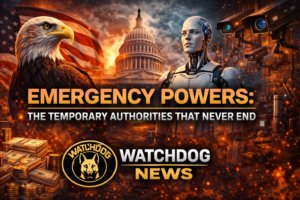
Emergency authorities often remain active long after crises end, reshaping modern governance.
Emergency Powers — The Temporary Authorities That Never End
How Crisis Governance, Presidential Inheritance, and AI Surveillance Quietly Reshaped American Power
By Jared W. Campbell — Watchdog News
Facts Over Factions
— The Quiet System Built for Crisis
Emergency powers are supposed to be temporary.
They exist for moments when normal government moves too slowly — war, disaster, pandemics, or national security threats. In those moments, speed matters more than procedure.
But the Watchdog question is not whether emergency authority should exist.
The Watchdog question is:
What happens after the crisis ends — when the legal posture never fully returns to normal?
Across decades, the United States has accumulated overlapping emergency authorities tied to terrorism, public health, cyber threats, economic sanctions, and border security.
Emergencies end.
Authorities rarely do.
And today, artificial intelligence and biometric surveillance may represent the next evolutionary stage of powers originally designed only for temporary use.
This report examines how that system works — and why critics and defenders alike acknowledge the same underlying reality:
Emergency governance tends to persist.
Part I — Emergency Powers Are Legal “Switches,” Not New Laws
Most Americans assume emergency powers are invoked during crises.
They aren’t.
They already exist in statute — waiting.
Declarations activate them.
Under frameworks like the National Emergencies Act (NEA), a presidential declaration serves as a legal trigger that unlocks authorities previously authorized by Congress. Continuation often requires only procedural renewal rather than new legislative approval.
This creates a structural imbalance:
-
Starting an emergency = executive action
-
Ending an emergency = political confrontation
Renewal becomes routine.
Termination becomes risky.
Part II — Why Emergencies Persist: Institutional Gravity
The persistence of emergency authority is rarely ideological.
It is structural.
1️⃣ Renewal Is Politically Safer Than Ending
Ending an emergency carries a risk if something later goes wrong.
Continuing, it looks administrative.
So continuation becomes the default behavior.
2️⃣ Bureaucratic Infrastructure Wants to Survive
Once emergency programs begin:
-
budgets adjust
-
agencies reorganize
-
contractors embed systems
-
data pipelines expand
Even if declarations expire, the machinery often remains.
Not a conspiracy.
Institutional momentum.
Part III — Presidential Administrations and the Expansion Cycle
One of your strongest Watchdog catches — and one often ignored — is this:
Emergency expansion has been cumulative and bipartisan.
Each administration inherits powers built during previous crises.
Post-9/11 — Expansion (Bush Era)
The War on Terror dramatically increased intelligence coordination and surveillance capacity.
Fear accelerated acceptance.
Security justified speed.
Oversight struggled to catch up.
Obama Era — Institutionalization
Rather than a rollback, many authorities became embedded in digital governance systems.
Federal modernization programs increasingly integrated public-facing and law enforcement digital infrastructure. DOJ modernization efforts emphasized expanding widely used federal digital services supporting public interaction and law enforcement systems
Emergency-era capabilities transitioned into routine administrative infrastructure.
Trump Era — Enforcement Expansion
Emergency declarations increasingly tied executive authority to immigration and border enforcement.
At the same time, federal agencies accelerated adoption of biometric identification and facial-recognition technologies, as examined in Congressional Research Service analyses of law-enforcement AI deployment.
https://www.congress.gov/crs-product/IN12458
Emergency authority increasingly intersects with identity verification technology.
Biden Era — Technological Governance
The policy focus shifted toward managing AI, which was already spreading across federal systems.
The Congressional Research Service warned that rapid AI innovation brings both benefits and risks, including “social, ethical, and security risks” alongside economic gains.
https://www.congress.gov/crs-product/IN12458
The challenge was no longer whether authority existed — but how to regulate tools already deployed.
The Pattern
Every administration argues necessity.
Every administration inherits expanded tools.
Few relinquish them.
Part IV — The Surveillance State Didn’t Arrive Overnight
The modern surveillance environment did not emerge from a single law or a single president.
It grew through incremental decisions:
-
database integration
-
biometric identity systems
-
AI-assisted analysis
-
cross-agency information sharing
AI sovereignty research warns that many modern technologies are dual-use, meaning systems built for civilian services can also serve surveillance or national-security purposes
https://www.brookings.edu/wp-content/uploads/2026/02/20260217_AI_sovereignty_final.pdf
This blurs traditional lines between governance and monitoring.
Part V — AI Changes the Scale of Emergency Authority
Here is where emergency powers fundamentally change.
Emergency law expands authority.
AI expands capacity.
That distinction matters.
AI enables governments to analyze massive datasets and automate decision-making at speeds beyond human capability.
RAND research examining AI’s military implications warns that the technology could reshape command structures, intelligence competition, and operational decision-making itself
https://www.rand.org/content/dam/rand/pubs/research_reports/RRA4300/RRA4316-1/RAND_RRA4316-1.pdf#:~:text=By%20using%20this%20building%20block%20approach%2C%20we,down%20warfare%20into%20component%20competitions%20revolving%20around.
Meanwhile, governance research notes AI systems can:
-
reinforce bias
-
expose sensitive data
-
enable misinformation
-
compromise privacy if poorly governed
Evolving Regulations and Emergence of
Agentic AI Fuel AI Governance Imperative
Emergency authority combined with automated systems produces something historically new:
continuous operational capability.
Part VI — Why Governments Defend These Powers
Security experts argue that expanded authority is rational.
Modern threats move faster than legislatures:
-
Cyberattacks unfold in minutes
-
AI enables adversaries as well as defenders
-
Infrastructure protection requires constant readiness
AI sovereignty frameworks emphasize national control over digital infrastructure as a core national-security priority
https://www.brookings.edu/wp-content/uploads/2026/02/20260217_AI_sovereignty_final.pdf
From this perspective:
Limiting emergency flexibility could leave governments unable to respond to modern threats.
Part VII — The Civil Liberties Warning
Critics do not primarily argue malicious intent.
They argue structural drift.
Civil-liberties analysts warn that normalization occurs when:
-
authorities renew automatically
-
Oversight depends on political will.
-
Emergency posture becomes routine governance.e
AI governance research emphasizes that ethical oversight frameworks are necessary because AI systems can produce “unexpected and undesirable outcomes” without accountability.
Evolving Regulations and Emergence of
Agentic AI Fuel AI Governance Imperative
The concern is not dictatorship.
It is permanence.
Part VIII — The Watchdog Insight
The real story is not fear.
It is an accumulation.
Crisis expands authority →
Technology increases capability →
Authorities remain →
The next administration inherits more powerful tools.
Over decades, governance shifts quietly.
AI surveillance does not arrive through one sweeping law.
It arrives through hundreds of small administrative decisions — each reasonable on its own.
Together, transformative.
Watchdog Audit Questions
Readers should ask:
-
When do emergency powers truly end?
-
Who audits annual renewals?
-
Which emergency declarations remain active today?
-
Who controls biometric and AI-generated data?
-
What safeguards exist against automated false identification?
Conclusion — Momentum, Not Malice
Emergency authority expands because threats are real.
But routine normalizes what fear creates.
When renewal becomes automatic and oversight invisible, extraordinary authority stops feeling extraordinary.
Democracies rarely change through sudden seizures of power.
More often, they evolve through inherited systems — each crisis adjusting the baseline slightly forward.
The challenge facing modern America is not whether emergency powers should exist.
It is whether temporary authority can remain temporary in an age where crises — and the technologies used to manage them — never fully end.
👁️ Watchdog Signature
At Watchdog News, the goal is not to alarm.
It is to observe patterns others overlook.
Because history rarely turns on a single decision.
More often, it shifts quietly —
one justified expansion at a time.
— Jared W. Campbell
Watchdog News | Facts Over Factions

Watchdog News Original Logo