

— Watchdog News
👁️ Facts Over Factions
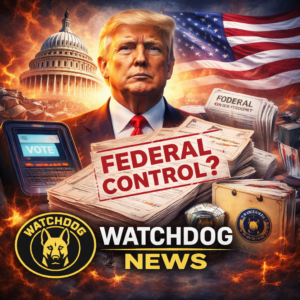
“Nationalizing Elections? What Trump Is Proposing — What’s Real, What’s Legal, and What It Could Mean”
By Jared W. Campbell — Watchdog News
👁️ Facts Over Factions
Introduction — Why This Story Matters
Every election cycle in America eventually reaches the same fault line:
Who controls elections — the states or the federal government?
Now that question has moved from academic debate into national headlines after former President Donald Trump called for actions critics describe as “nationalizing” U.S. elections.
Supporters say the effort is about restoring election integrity.
Critics warn it could fundamentally reshape how American democracy operates.
A Watchdog approach requires stepping back from political reactions and asking a simpler question:
What is actually being proposed — and is it even possible under U.S. law?
1️⃣ What Is Verified: Trump Has Pushed Federal Election Control Measures
Multiple outlets confirm Trump has supported sweeping federal involvement in election administration.
In 2025, Trump signed an executive order seeking to overhaul federal election procedures, including:
-
Requiring proof of U.S. citizenship for voter registration
-
Mandating ballots be received by Election Day
-
Directing federal agencies to share data with states to identify non-citizens on voter rolls
-
Conditioning federal election funding on compliance with new standards
According to Associated Press reporting, the order sought to use federal authority to influence how states administer elections, a traditionally local matter.
Supporters framed the move as strengthening election security.
Opponents immediately argued it risked disenfranchising lawful voters and exceeding presidential authority.
2️⃣ What “Nationalizing Elections” Actually Means
The phrase itself is political shorthand — not a formal legal term.
In practice, proposals discussed or implied include:
-
Federal voter ID or citizenship verification standards
-
Nationwide ballot handling rules
-
Federal oversight tied to funding penalties
-
Centralized data coordination between federal agencies and states
State and local election officials have publicly warned they are preparing for potential federal intervention following Trump’s calls to “nationalize” elections.
But here’s the key Watchdog distinction:
👉 This would not mean Washington is literally running polling stations.
It would mean Washington setting mandatory national rules that states must follow.
3️⃣ The Constitutional Reality (Often Missing From Online Debate)
The U.S. Constitution creates a shared system.
Article I, Section 4 — the Elections Clause — states:
States run elections, but Congress may alter regulations.
This creates a balance:
-
States administer elections day-to-day.
-
Congress can set federal standards.
Legal scholars widely note that presidents alone cannot fully federalize elections without congressional action or surviving court challenges.
Courts have repeatedly reinforced limits on centralized control. A recent Supreme Court ruling reaffirmed that state courts still retain oversight over election rules created by state legislatures.
Translation:
Any attempt at sweeping national control would almost certainly face immediate constitutional litigation.
4️⃣ Supporters’ Perspective — Election Integrity
Supporters of federal standards argue:
-
Elections determine national leadership and therefore require national safeguards.
-
Different state rules create confusion and uneven security.
-
Federal data coordination helps prevent fraud or foreign interference.
From this perspective, federal involvement is not authoritarian — it is modernization.
Many conservatives argue that decentralized election systems leave vulnerabilities that adversaries could exploit.
5️⃣ Critics’ Perspective — Federal Overreach
Opponents raise three major concerns:
A. Constitutional Authority
They argue that election administration has historically been state-based to prevent centralized political control.
B. Voter Access
Civil rights advocates warn that documentation requirements could disproportionately affect:
-
Married voters with name changes
-
Rural voters
-
Elderly citizens lacking paperwork
C. Political Neutrality
Critics fear that whichever party controls federal power could shape election rules nationwide.
In their view, a centralized election authority risks turning federal elections into partisan battlegrounds.
6️⃣ The Bigger Watchdog Context
This debate didn’t appear out of nowhere.
It sits at the intersection of three long-running trends:
-
Post-2020 election distrust
-
Increasing federal involvement in state policy areas
-
Rising polarization over election legitimacy
Both parties have historically supported federal election laws when politically advantageous — from the Voting Rights Act to federal campaign finance rules.
So the deeper issue may not be new power, but who controls it.
7️⃣ Watchdog Questions That Actually Matter
Instead of slogans, these are the questions journalists should be asking:
-
Would Congress need to approve national election standards?
-
What specific powers would federal agencies gain?
-
Could states legally refuse compliance?
-
Would courts block enforcement?
-
Does uniformity increase trust — or reduce local accountability?
Watchdog Conclusion
Right now, the phrase “nationalizing elections” functions more as a political signal than a finalized policy.
What is real:
✅ Trump has pushed for expanded federal election authority.
✅ Legal battles are expected if implemented.
✅ States remain constitutionally central to election administration.
What is not yet real:
❌ A federal takeover of elections.
❌ A finalized national election system run from Washington.
From a Watchdog perspective, this moment reveals something deeper than partisan politics:
America is debating whether democracy works best when power is local and fragmented — or standardized and centralized.
And history shows one truth:
The structure of elections often matters as much as the outcome.
👁️ Watchdog Standard
Ask harder questions.
Separate law from rhetoric.
Follow structure — not slogans.
Facts over factions.

— Watchdog News
👁️ Facts Over Factions