

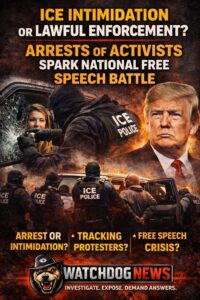
ICE Intimidation or Lawful Enforcement? Arrests of Activists Spark National Free Speech Debate
By Jared W. Campbell
Iraq War Veteran | Host of Watchdog News
“Democracy does not rest upon the number of police officers, but upon their commitment to uphold the rights of citizens — even those willing to challenge authority.”
Across the United States, a troubling pattern is emerging.
Individuals who observe, record, or follow ICE (Immigration and Customs Enforcement) operations are increasingly being arrested, monitored, or threatened with federal charges. Supporters of these actions argue they are necessary to protect officer safety and maintain law and order. Critics, however, claim something far more serious is unfolding — a coordinated effort to intimidate dissent and discourage citizens from monitoring government activity.
At Watchdog News, we focus on facts rather than slogans. This raises several important questions:
- Are peaceful observers being improperly criminalized?
- Is ICE exceeding its authority?
- Or are these lawful arrests involving genuine interference with federal operations?
This report examines the incidents, the law, and the constitutional questions now shaping a growing national debate.
INCIDENT THAT DREW NATIONAL ATTENTION
The Arrest of Becky Ringstrom
On January 29, 2026, in Minneapolis, Minnesota, Becky Ringstrom, a 42-year-old mother of seven, noticed federal officers operating without clear identifying markings in her neighborhood. Concerned that an ICE operation might be underway, she chose to document what she believed was government activity occurring in public view.
According to reports, Ringstrom followed federal vehicles in her SUV for approximately 45 minutes while maintaining distance. The situation escalated when several unmarked vehicles surrounded her. Federal officers exited the vehicles, and one officer allegedly shattered her windshield with a metal object before placing her under arrest.
Ringstrom was charged under Title 18, Section 111 of the United States Code, which criminalizes assaulting, resisting, or obstructing a federal officer.
Ringstrom denies wrongdoing. ICE officials maintain that her actions constituted obstruction.
Some sources further claim she was later placed on a federal monitoring list — a claim that has intensified concerns about citizen oversight and government accountability.
RISING NUMBER OF ARRESTS
Investigations reported by Reuters indicate that since immigration enforcement intensified last summer, at least 655 individuals nationwide have been charged under the same obstruction statute — more than double the number charged during the same period the previous year.
Many of those arrested were volunteers or activists attempting to document ICE activity in their communities.
Federal authorities argue these prosecutions protect officers from potential harm. Civil rights organizations counter that the trend represents the criminalization of dissent.
ICE MONITORING OF ACTIVISTS AND MEDIA
Reports indicate that ICE has developed internal monitoring systems tracking individuals who document or oppose agency operations. These files reportedly include photographs, vehicle information, and location data.
The Department of Homeland Security denies operating a “domestic terrorism database,” stating the information is collected solely for national security assessments.
Civil liberties advocates remain concerned, arguing that compiling data on citizens exercising First Amendment rights risks creating a chilling effect on free speech.
COMPETING VIEWPOINTS IN THE NATIONAL DEBATE
Government Perspective
Officials within DHS and ICE state that they maintain a zero-tolerance policy toward interference with law enforcement. According to federal authorities, arrests occur only when individuals obstruct operations or create unsafe conditions.
DHS spokesperson Tricia McLaughlin stated:
Assaults and obstruction involving law enforcement are felony offenses. Officers will be protected.”
From this perspective, enforcement actions are necessary to maintain operational safety and prevent escalation.
Civil Rights Perspective
Organizations such as the ACLU and the Knight First Amendment Institute argue that observing or recording law enforcement in public spaces is constitutionally protected speech.
They contend that aggressive enforcement of obstruction statutes risks suppressing lawful oversight. Former ICE official Deborah Fleischaker stated:
“Watching ICE is not a crime and should not be treated as one.”
Critics argue that surveillance of observers and arrests like Ringstrom’s may discourage citizens from exercising protected rights.
Legal Experts Weigh In
Legal scholars note that Title 18, Section 111 traditionally applies when an individual physically interferes with officers, resists arrest, or poses a direct threat.
Simply observing from a distance typically does not meet that legal threshold.
Some federal judges have begun scrutinizing these cases more closely, emphasizing that peaceful observation alone does not constitute obstruction without clear evidence of interference.
A NATION IN ESCALATING TENSION
Immigration enforcement has become one of the most divisive issues in modern American politics. Demonstrations have occurred in cities including Los Angeles, Portland, and Minneapolis. Community “rapid response” teams now monitor ICE activity, while confrontations between activists and enforcement agencies continue to increase.
At the same time, some elected officials describe certain protests as threats to public safety. The result is a cycle of escalating mistrust between citizens and government authorities.
THE CONSTITUTIONAL QUESTION
At the heart of this controversy lies a foundational principle:
Citizens in a free society retain the right to observe their government.
Generally accepted legal principles include:
- Citizens may observe police activity in public spaces.
- Journalists may document government actions.
- Protesters may express dissent peacefully.
However:
- The right to observe is protected.
- The right to obstruct is not.
The challenge lies in defining where that line exists.
OBJECTIVE REALITIES
Both perspectives contain legitimate concerns:
- ICE possesses lawful authority to enforce immigration law.
- Law enforcement has a duty to protect officer safety.
- Genuine obstruction is a crime.
At the same time:
- Peaceful filming does not automatically equal obstruction.
- Monitoring lawful protest activity raises concerns about civil liberties.
- Arresting peaceful observers could violate constitutional protections.
These competing truths now collide in courts and communities nationwide.
WATCHDOG NEWS CONCLUSION
This debate extends far beyond Minneapolis or one individual case.
It touches the core of American democracy — the balance between enforcement and intimidation, authority and accountability.
A free society depends on both lawful enforcement and protected civil rights. When that balance becomes unclear, scrutiny is not only appropriate — it is necessary.
At Watchdog News, our commitment remains unchanged:
We follow the truth wherever it leads and hold power accountable regardless of politics or position.
That is what it means to be a Watchdog.
WATCHDOG NEWS
Investigate. Expose. Hold Accountable.
Facts — Not Factions.