

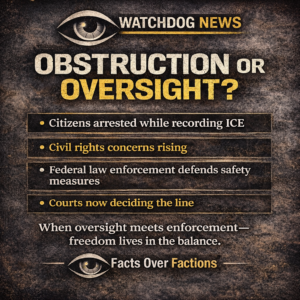
“Obstruction or Oversight? — The Growing Fight Over ICE Enforcement and Civil Liberties”
By Jared W. Campbell
Iraq War Veteran — Watchdog News
Facts Over Factions
When Recording the Government Becomes the Story
One thing Watchdog reporting teaches you quickly:
The truth usually lives in the space between two shouting sides.
Recently, headlines have claimed that immigration authorities are using a so-called “dark law” to silence protests and intimidate citizens. Others insist federal agents are simply enforcing laws designed to protect officers during dangerous operations.
So which is it?
A crackdown on civil liberties — or enforcement of existing federal law?
Let’s slow down and examine what can actually be verified.
1️⃣ The Law at the Center of the Controversy
The statute being discussed is 18 U.S.C. §111.
This law makes it illegal to:
Assault, resist, oppose, impede, intimidate, or interfere with federal officers performing their duties.
Important facts:
• It is not new.
• It was not created for immigration enforcement.
• It applies to all federal officers — FBI, DEA, Marshals, Secret Service, and ICE alike.
• Penalties increase if violence or injury occurs.
Calling it a “dark law” is political framing, not a legal classification.
2️⃣ Why American Citizens Are Being Arrested
Here’s where confusion begins.
You do not need to be an immigrant to be charged under this statute.
Citizens can face charges if authorities believe they:
• interfered with an operation,
• ignored lawful commands,
• followed agents too closely,
• or created operational risk.
Federal law protects officers during active enforcement actions — regardless of politics.
3️⃣ The Civil Liberties Argument
Civil rights attorneys raise a serious concern:
Americans have a First Amendment right to:
✅ record government officials in public
✅ observe law enforcement
✅ protest peacefully
Federal courts have repeatedly affirmed this right.
Critics argue that labeling filming or protest activity as “obstruction” risks chilling free speech and discouraging public oversight.
From this perspective, arrests — even if charges are later dropped — can serve as a form of intimidation.
4️⃣ The Law Enforcement Perspective
Federal agencies present a very different view.
They argue:
• Immigration operations can be volatile.
• Officers must control scenes quickly.
• Following vehicles or refusing commands can endanger agents and bystanders.
From their standpoint, enforcement is about safety — not silencing dissent.
5️⃣ The Data Problem
Some reports claim prosecutions under this law have increased dramatically.
But Watchdog analysis raises key questions:
• Are arrests rising because enforcement activity increased?
• Because protests increased?
• Because prosecutorial standards changed?
Higher numbers alone do not prove rights violations.
Context matters.
6️⃣ What Courts Are Actually Showing
One overlooked detail:
Many arrests tied to these incidents have resulted in:
• dismissed charges,
• reduced charges,
• or no prosecution.
That creates two competing interpretations:
Critics say: arrests were excessive.
Authorities say: prosecutors filtered cases after investigation.
The legal system — not headlines — ultimately determines misuse.
👁️ The Watchdog Questions That Matter
Instead of choosing sides, ask better questions:
• Were individuals arrested for filming alone — or for interference?
• What do bodycam recordings show?
• Were lawful orders ignored?
• Did judges criticize enforcement actions?
• Are constitutional limits being clarified in court?
These answers decide whether this is enforcement… or overreach.
🧭 Watchdog Conclusion
This story isn’t about immigration alone.
It’s about a deeper American tension:
Where does citizen oversight end and obstruction begin?
Government power requires accountability.
But enforcement requires authority.
A free society survives only when both exist simultaneously.
The real danger isn’t asking questions.
It’s stopping before the answers get uncomfortable.
👁️ Facts over factions.
— Jared W. Campbell
Watchdog News